
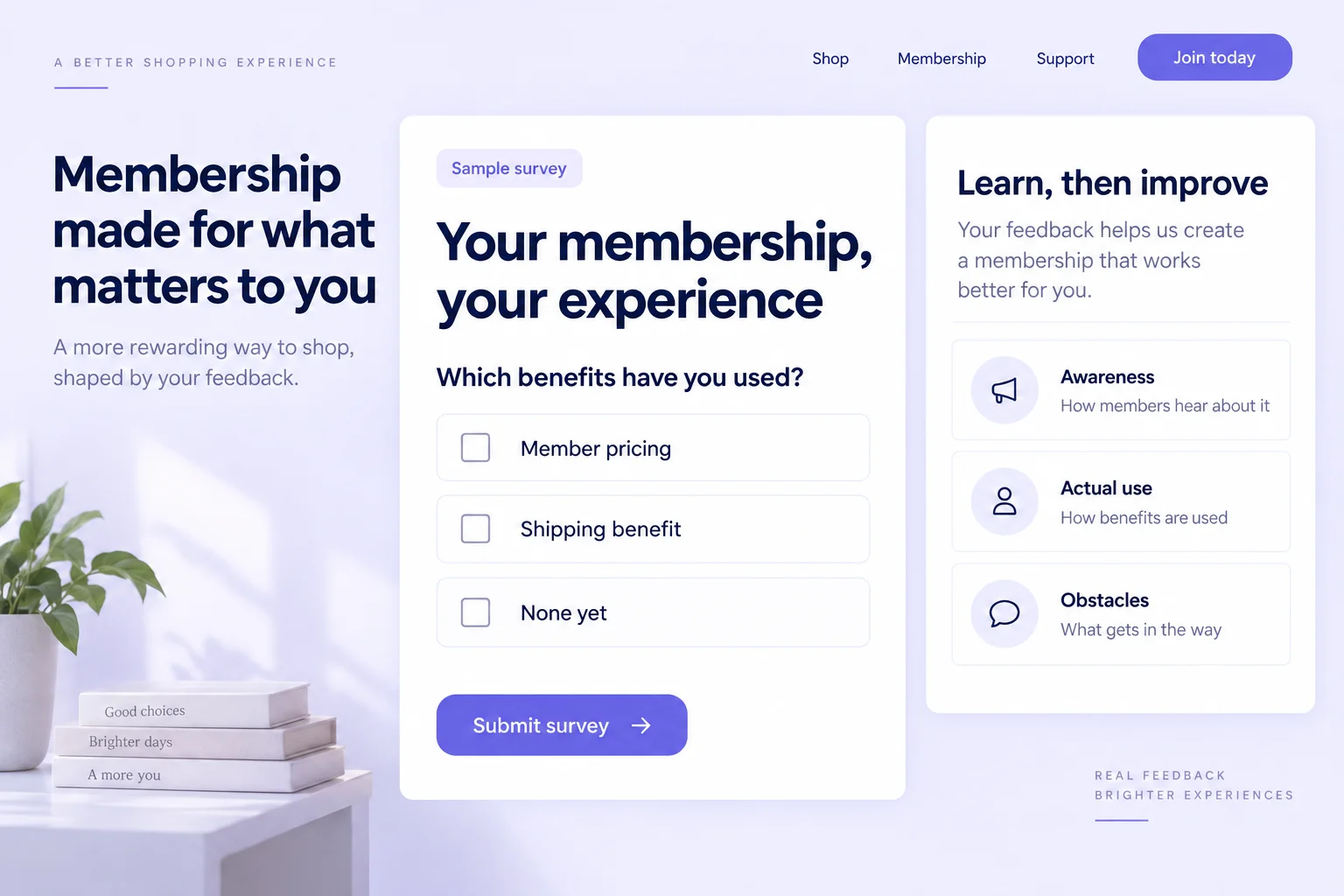
What is a membership survey?
A retail membership survey asks shoppers about their ongoing relationship with a paid or free customer program: what they understand, which benefits they use and whether the experience fits their needs. It should help you choose a specific improvement, not just collect a satisfaction score.
A shopper can know about a benefit without using it, use it without valuing it, or value it while still finding the fee unaffordable. Keep those questions separate. For delivery, product quality or a single order, use the post-purchase survey questions instead.
The original question sets below are a starting point for Shopify retail memberships, not association or professional-body surveys. Replace bracketed text with your actual benefits and dates. Do not send the whole bank to everyone.
Choose the decision and audience first
- New members: Can shoppers explain the offer and find their benefits? Use this to improve the welcome and onboarding experience.
- Active members: Are benefits useful during a normal buying cycle? Use this to review benefit rules, visibility and fit.
- Former members: What contributed to leaving? Use this to investigate the offer or experience without pressuring people to return.
Survey quiet members as well as frequent buyers. Choose a defined group, such as everyone who joined a particular tier in a given month, and record how many were invited. Keep paid and free members separate when asking about price. A free member cannot evaluate a fee they never paid.
Start with three to five relevant questions and an optional comment. This is a working format, not a universal optimum. Choose a recall period that fits your purchase cycle: the last 30 days might suit regular replenishment, while a seasonal store may need a longer, clearly dated period.
Four questions for new members
1. In your own words, what did you expect to receive when you joined?
Response format: Optional short text, before displaying a benefit list.
Decision it informs: Compare expectations with your actual offer. Rewrite unclear promises rather than treating a mistaken expectation as customer error.
2. Before this survey, were you aware that your membership included [benefit]?
Response format: Ask separately for each core benefit: Yes / No / Not sure.
Decision it informs: Find awareness gaps. Ask before explaining the benefit so the question does not teach the answer.
3. Have you tried to find the details of your membership benefits?
Response format: Yes, and I found them / Yes, but I did not find them / No, I have not tried / I do not remember.
Decision it informs: Separate difficulty finding information from not having looked yet.
4. What, if anything, is still unclear about your membership?
Response format: Optional short text.
Decision it informs: Identify missing explanations about eligibility, timing or how to use the offer. Address recurring confusion in the welcome information.
Five questions for active members
5. During [start date] to [end date], did you use [benefit]?
Response format: Ask once per relevant benefit: Yes / No / Not sure.
Decision it informs: Distinguish reported use from awareness. Check reliable records separately where available; self-reported use is not a transaction log.
6. What was the main reason you did not use [benefit] during that period?
Response format: Only if No: I did not need it / I did not know it was included / I could not work out how to use it / My purchase was not eligible / Another offer suited me better / Another reason, optional text / Not sure. Choose one.
Decision it informs: Investigate the main obstacle. Low use may reflect a normal gap between purchases, not dissatisfaction.
7. How useful was [benefit] when you used it?
Response format: Only if Yes: Very useful / Somewhat useful / Neither useful nor unhelpful / Somewhat unhelpful / Very unhelpful / Not sure.
Decision it informs: Find benefits that are used but do not solve a meaningful customer need.
8. Thinking about the membership fee you paid for [period], how would you rate the value you received?
Response format: Paid members only: Very good / Somewhat good / Neither good nor poor / Somewhat poor / Very poor / Too early to judge / Not sure.
Decision it informs: Review perceived value alongside actual usage and costs. This does not establish an acceptable price or predict renewal.
9. What one change, if any, would make the membership more useful to you?
Response format: Optional short text.
Decision it informs: Look for repeated, specific needs. Evaluate the cost and feasibility of ideas instead of promising every requested perk.
Four questions for former members
10. What was the main reason you decided to leave the membership?
Response format: I was shopping less often / The fee did not fit my budget / The benefits were not useful enough / Benefits were difficult to use / Another option suited me better / I did not intend to leave / Another reason, optional text / Prefer not to say. Choose one.
Decision it informs: Separate purchase frequency, affordability and benefit friction. Route an unintended exit for investigation rather than labelling it a value problem.
11. Was there anything else that contributed to your decision?
Response format: Optional short text.
Decision it informs: Allow multiple contributing reasons without requiring a long cancellation interview.
12. What will you most likely do instead of using this membership?
Response format: Shop here without membership / Use another program / Buy elsewhere without a program / Buy less or stop buying these products / Something else / Not sure. Choose one.
Decision it informs: Understand the alternative. Leaving a membership does not necessarily mean leaving the store.
13. What, if anything, could we have explained more clearly before you joined?
Response format: Optional short text.
Decision it informs: Improve the joining page and benefit terms. Treat hindsight as useful feedback, not proof of what caused the exit.
Keep the survey neutral and easy to answer
Pew Research Center’s questionnaire guidance explains why wording, answer choices and question order matter. Ask about one idea at a time, use balanced options and test whether people understand the question before sending it widely.
Replace “How much do you love our exclusive perks?” with “How useful was [benefit] when you used it?” Replace “Was joining easy and good value?” with separate questions about finding benefit information and the value received. Include “Not sure,” “Not applicable” or a skip path when the person may not have the experience needed to answer.
Ask unaided expectations before showing a list of benefits. Preserve wording, scale order and recall period when comparing successive surveys, or document what changed. Try the form on a phone and ask a few people to explain each question back to you. Do not ask them to supply payment details or unrelated personal information.
Make participation optional and explain how answers will be used. Only describe responses as anonymous if your actual collection process supports that claim. Keep a visible support route for a broken benefit; a survey is not a substitute for helping that shopper.
Turn answers into a testable improvement
Fictional example: A store invites 200 active paid members and receives 40 completed questionnaires. That is 40 ÷ 200 = 20% of invited members. Assume all 40 answer the benefit-awareness and use questions: 24 report knowing about the shipping benefit, and 10 report using it in the stated period. Those are 60% and 25% of respondents, respectively, not of all members.
The counts do not show how many of the 24 aware respondents used the benefit unless you examine the paired responses. Nor do they show that awareness caused use. The 160 nonrespondents may have different experiences. Do not claim “75% of our members never use shipping” from this sample.
Suppose repeated comments say the eligible shipping threshold is hard to find. First check the actual terms and customer journey. Test a clearer explanation in the welcome information, then review relevant usage and subsequent feedback. Keep the fee and benefit rules stable if you want to isolate that communication change; even then, a simple before-and-after comparison is not proof of causation.
- Report invited, completed and question-level response counts, plus the survey dates and tier.
- Keep skipped or inapplicable answers separate from negative answers. Use the denominator for that particular question.
- Group comments into themes while retaining contradictory feedback. Avoid drawing conclusions from tiny subgroups.
- Do not add percentages from multiple-choice questions when people could select several options.
- Use stated preferences to form hypotheses. Verify renewal, purchase and benefit-use outcomes separately.
Use the membership benefits guide to review the offer and the subscription fatigue guide when a recurring fee may not fit the shopper.
Where Memberply fits
Memberply lets Shopify merchants configure membership tiers and benefits. It also supports configurable cancellation reasons to learn why members leave. A cancellation reason is one piece of feedback, not a complete satisfaction survey.
Use your own chosen survey process for the broader questionnaire. This guide does not imply native survey building, automatic audience selection, response collection or survey rewards in Memberply. Review themes alongside the membership information you can reliably access, and use the retention guide to plan the next improvement.
Membership survey FAQs
What should a retail membership survey ask?
Ask separately about benefit awareness, actual use, obstacles and perceived value. Choose questions for the member’s stage and connect every answer to a decision you can make.
How many membership survey questions should I use?
Start with three to five relevant questions and one optional comment. This is a practical starting point, not a response-rate benchmark. Test the survey on a phone and remove questions you cannot act on.
When should I survey members?
Ask new members about understanding after they have seen the welcome information. Ask active members after a realistic opportunity to use benefits, and invite former members to give optional feedback after leaving.
Can survey answers predict renewals?
No. Stated intentions are not observed renewals. Use answers to investigate problems, then check actual benefit use and renewal outcomes separately.
Does Memberply include a general membership survey builder?
This guide does not describe a native survey builder. Memberply supports configurable cancellation reasons; collect a broader questionnaire through your own chosen survey process.