
Protect rewards without treating every anomaly as fraud
Loyalty program fraud prevention combines clear eligibility rules, reliable reward processing and evidence-based review. The aim is to prevent rewards going to ineligible activity while keeping the program usable for legitimate members.
Intentional deception, promotion abuse and a software error can produce similar-looking records. A duplicated reward may come from repeated event processing. A shared address may belong to a household with separate customers. A frequent return may have a valid product-related explanation. Start by establishing what happened.
For a Shopify merchant, the practical questions are: what qualifies, when a reward is issued, what a return changes and who can correct an error? This guide covers those decisions and the documented controls in Memberply. It does not describe an automatic fraud-scoring product.
Seven loyalty risks to review
| Scenario | What to review | Safeguard to verify |
|---|---|---|
| Repeated signup or joining benefits | Membership and reward history, access-end dates and the published offer. A returning customer may simply be following the current rules. | Clear eligibility and, where appropriate, a supported rejoin waiting period. |
| Referral abuse | The referrer, attributed conversion, payment state and whether a reward was already issued. | Self-referral and duplicate checks, the correct conversion goal and qualification timing. |
| Rewards retained after a return | Original qualifying order, refund, issued reward and any redemption or previous adjustment. | Documented behavior before and after reward issuance, with a manual exception process where needed. |
| Duplicate rewards | Whether the same qualifying event or order appears more than once in the reward history. | Processing that is safe to repeat and reconciliation of duplicate deliveries. |
| Unexpected benefit combinations | The actual mixed basket, active discounts, credit and required sales channel. | Tested combination rules and a budget for permitted offers. An allowed combination is not automatically abuse. |
| Account access concerns | Whether the person requesting a change has access through the supported customer-account process. | Secure account recovery and verification of reward ownership before sensitive changes. |
| Unexplained staff adjustments | Who made the change, why, what was approved and whether another adjustment already handled it. | Appropriate permissions, recorded reasons and review of exceptional corrections. |
These are review scenarios, not proof that a customer acted dishonestly. Use the referral guide to make qualification clear in invitations, and the renewal guide to explain membership dates accurately.
Download the loyalty safeguards checklist
Use the free workbook to record 12 control checks, their current limitations, evidence and owners. It also includes eight test scenarios, including legitimate member behavior and correction of a mistaken decision. The CSV contains the 12 control checks only. No email address is required.
This is a manual planning aid, not a customer watchlist or fraud detector. Use test identities and references to evidence in your authorized systems, rather than copying personal customer data into a shared spreadsheet.
Memberply controls and their limits
Configure the controls that apply to your offer, then test them with the actual membership tier and account experience. The settings below solve specific problems; they should not be presented as complete identity or fraud detection.
| Control | What it supports | Important limit |
|---|---|---|
| Referral qualification | Choose membership signup or a friend’s first store purchase as the conversion goal. Membership signup rewards can wait for the referred friend’s first successful membership payment. | These are different conversion rules. Do not assume every referral has the same reward timing. |
| First-purchase referral review | The referral remains pending for 14 days. Cancellation, voiding or refund before issuance disqualifies it. | An already delivered reward is not automatically removed after a later refund. |
| Referral duplicate checks | Memberply prevents self-referrals and duplicate referral rewards for the same customer or order. | This is not a guarantee of matching every person across separate accounts. |
| Uncertain referral credit delivery | If a Shopify credit request may have been received but its final outcome is unclear, Memberply holds the reward for review rather than risking another credit. | Review the existing delivery before attempting a manual correction. |
| Tier rejoin cooldown | A configured waiting period can prevent repurchase of the same tier after membership access ends. | It is tier-specific and has identity-matching limits. Another email or account is not guaranteed to be recognized as the same person. |
| Spend-tier refund setting | Spend Tiered Discounts can allow refunds to reduce an earned level when eligible spend falls below its threshold. | Keeping the highest earned level is also a supported choice. This setting does not establish reversal behavior for every other benefit. |
See the referral documentation, rejoin cooldown instructions and spend-tier settings. The cooldown starts when access actually ends, not necessarily when the member first requests cancellation.
Memberply delivers eligible referral credit through native Shopify store credit for customer accounts, or as a discount code for legacy customer accounts. Verify the actual reward form before choosing a correction process. Do not assume a native balance adjustment also changes a legacy discount code.
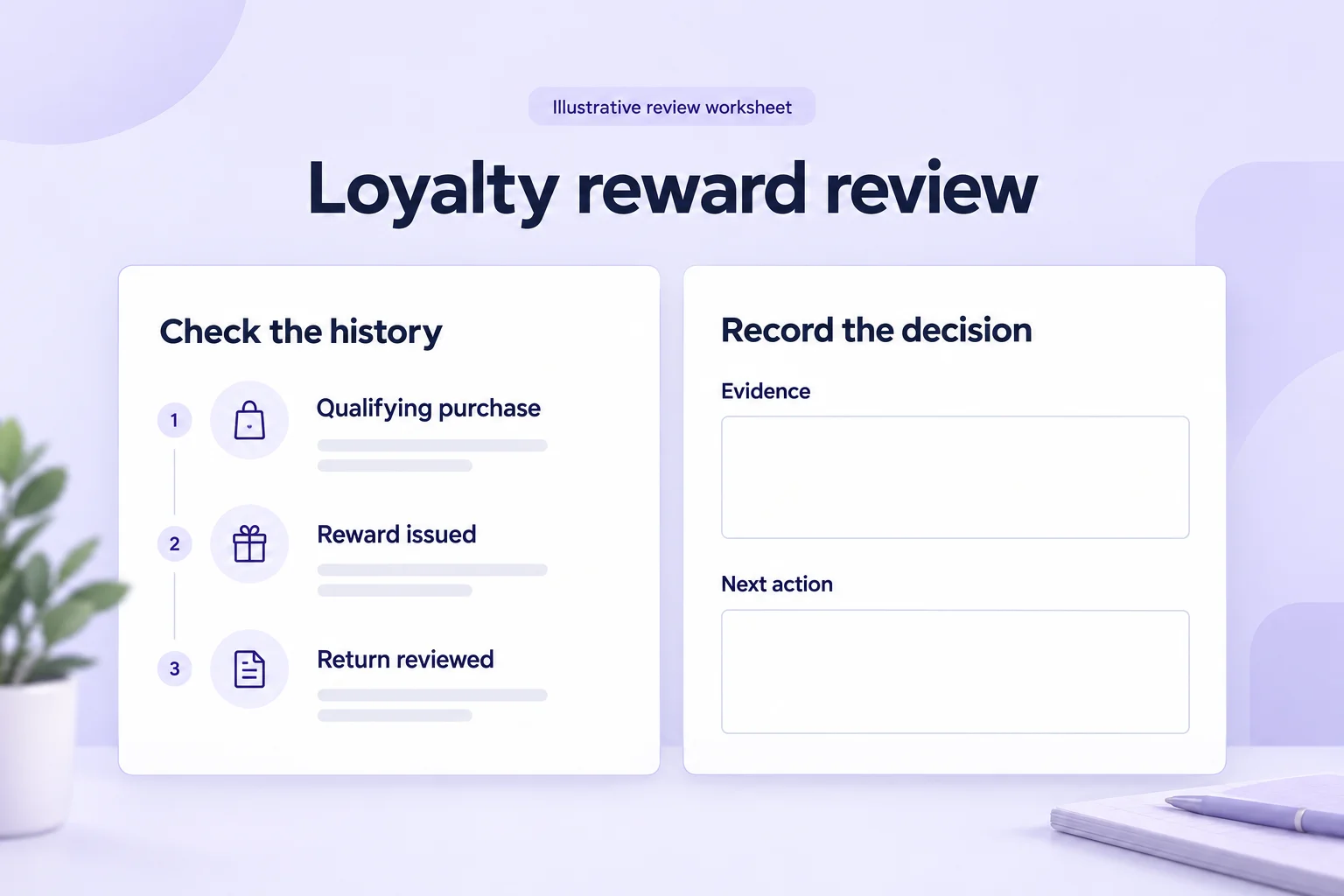
Review the whole reward history before a correction
A return can affect several records: the order payment, qualifying spend, pending rewards, delivered credit and a later purchase that used the credit. Treating these as one balance can lead to a mistaken or duplicate adjustment.
Identify the qualifying event
Match the reward to the original membership conversion or order. Confirm its current payment, cancellation and refund state, including partial refunds.
Check whether the reward is pending or delivered
A pending first-purchase referral and an already issued referral reward have different handling in Memberply. Check the delivery record rather than assuming the passage of time proves issuance.
Review later activity
Check redemption and previous adjustments. Record what remains available and which system owns the relevant balance or code.
Apply only an authorized correction
Use the documented process for the actual benefit, your published program rules and an appropriate reviewer. Explain the outcome clearly and retain the reason. Do not automatically remove unrelated benefits.
For example, a fictional first-purchase referral order is refunded while the reward is still pending: Memberply disqualifies that referral. If the refund happens after the referral reward was delivered, the reward is not automatically removed. The second case needs review; it is not evidence that the customer intended to exploit the program.
Shopify supports permission-controlled store-credit adjustments. Its documentation also notes that refunding to the original payment method after an earlier store-credit refund does not itself reverse the issued store credit. Review Shopify’s store-credit guidance before making an adjustment. Do not copy a correction from one reward type to another without checking the records.
Keep order fraud checks separate from loyalty eligibility
A valid payment does not prove a referral qualifies, and a loyalty-rule exception does not prove payment fraud. Review the two questions separately.
Shopify’s fraud analysis provides order indicators and, for eligible orders, a risk recommendation. Availability varies by order type; for example, Shopify lists subscription renewal orders among those without a fraud recommendation. Its guidance also says individual indicators do not represent the overall risk level. See Shopify’s fraud-analysis documentation.
Do not treat a shared address, network or unusually large order as a verdict. Use corroborating history, the actual program rules and a human review when the consequence would affect a legitimate member. Keep sensitive payment and account information inside the supported platform workflows.
Create a fair, repeatable review process
Name the rule and the evidence
Record which condition may not have been met and link to the relevant order, membership and reward records. Keep suspicion separate from confirmed facts.
Check ordinary explanations
Look for support-approved exceptions, household purchases, a corrected order, delayed synchronization or a duplicate event. A confusing rule may need clearer communication rather than enforcement.
Choose a proportionate action
Use supported controls and an authorized reviewer. If a temporary restriction is appropriate, define what it affects, who owns the review and when it will be revisited. A suggested review process is not a promise of a native hold feature.
Explain and allow correction
Describe the applicable program rule and the action taken without making an unsupported accusation. Give the member a way to ask for review and correct a mistaken decision.
Fix the underlying cause
If the issue came from configuration or repeated processing, repair and test that behavior. Do not keep treating each affected customer as a separate fraud incident.
For custom integrations, include replay and reconciliation tests in the implementation checklist. Confirm who owns recovery in the integration plan. The guide does not establish device fingerprinting, automated identity matching or a native fraud case-management system as Memberply features.
Measure incorrect rewards and customer friction
| Measure | Definition to agree |
|---|---|
| Review rate | Cases opened divided by the relevant qualifying events in the same period. A review is not a confirmed fraud case. |
| Confirmed issues | Reviewed cases with evidence of an eligibility violation, processing error or another defined outcome. Report those outcomes separately. |
| False-positive share | Completed reviews found to be legitimate divided by completed reviews. State how unresolved cases are treated. |
| Reward value affected | Issued, redeemed and corrected amounts recorded separately in a consistent currency. Do not count the same value as both prevented and recovered. |
| Resolution time | Time from review opening to a recorded decision, including cases still waiting beyond the target. |
| Repeat defects | Whether the same configuration or integration failure returns after a fix. |
In a fictional example, 20 completed reviews include 5 confirmed eligibility issues, 3 processing errors and 12 legitimate cases. The legitimate-case share is 12 ÷ 20 = 60%. This describes the review process, not the fraud rate of the whole program or a Memberply benchmark. It suggests checking whether the review rule is too broad.
Review these measures alongside member support and retention. Do not claim every withheld reward is money saved; the member may have qualified, and an unredeemed reward is not the same as realized loss. Use the loyalty KPI guide for wider program reporting.
Loyalty fraud prevention FAQs
What is loyalty program fraud?
Loyalty program fraud involves intentional deception to obtain rewards or access that a person is not entitled to receive. Unusual activity can also come from legitimate behavior, unclear rules or a software error, so review evidence before deciding what happened.
Does Shopify fraud analysis detect all loyalty abuse?
No. Shopify order fraud analysis and loyalty qualification checks address different questions. An order risk assessment does not establish whether a referral, signup reward or membership benefit meets your program rules.
Does Memberply prevent self-referrals?
Memberply prevents a member from referring themselves and prevents duplicate referral rewards for the same customer or order. These checks do not establish that every apparently separate account belongs to a different person.
When are first-purchase referral rewards issued?
Memberply first-purchase referrals remain pending for 14 days. A qualifying order cancelled, voided or refunded before issuance is disqualified. Rewards already delivered are not automatically removed after a later refund.
Can a rejoin cooldown stop repeated membership purchases?
It can block a former member from repurchasing the same tier during the configured waiting period. The period starts when access ends. The check has identity-matching limits and does not prevent every purchase through a different email address or account.
Should I remove a reward whenever an order is refunded?
Follow the actual benefit rules and review what has already happened. Pending rewards, issued credit, redeemed points and earned spend levels can behave differently. Do not assume a refund automatically reverses every reward or apply a second adjustment without checking the history.
Does the free checklist detect fraud automatically?
No. The XLSX workbook and CSV are manual review aids. They help record controls, limitations, tests and owners. They do not connect to Shopify, score customers, alter rewards or change account access.