
What is subscription fatigue?
Subscription fatigue is the feeling that recurring charges and the work of managing them no longer justify the value received. For a shopper, the question can be simple: “Will I use this enough to pay for it again?” A retail membership competes for the same household budget and attention as other commitments.
Shopify identifies subscription fatigue as an ecommerce subscription challenge. That does not mean every shopper rejects recurring offers. It means merchants should test the usefulness of the offer rather than assume that a discount, exclusive label or long perk list makes another fee attractive.
This guide focuses on designing a consumer membership before launch. For the ongoing work of keeping existing members informed and supported, use the membership retention guide.
Find the reason behind “not another membership”
On small screens, scroll the table horizontally to see every column.
| Possible concern | What to ask or check | Offer-design response |
|---|---|---|
| Affordability | Does the fee fit the shopper's budget even if the benefits are useful? | Keep a useful one-off buying path. A mathematically positive saving does not make an upfront fee affordable. |
| Overlapping benefits | Does the shopper already get the discount or shipping benefit through public offers? | Describe only the additional value membership provides. |
| Low purchase frequency | How often does the person naturally need another order? | Consider free loyalty or no membership change rather than requiring more purchases to justify the fee. |
| Unused or confusing perks | Can the shopper find, understand and use the main benefit? | Simplify the offer and test the first benefit-use journey. |
| Payment failure | Was there a billing problem rather than a decision to leave? | Investigate separately. Failed payments alone do not establish subscription fatigue. |
Ask customers in neutral language what they expected and what got in the way. Do not label every quiet member as dissatisfied: an occasional buyer may simply be between purchases.
Use a benefit-use diary before choosing the offer
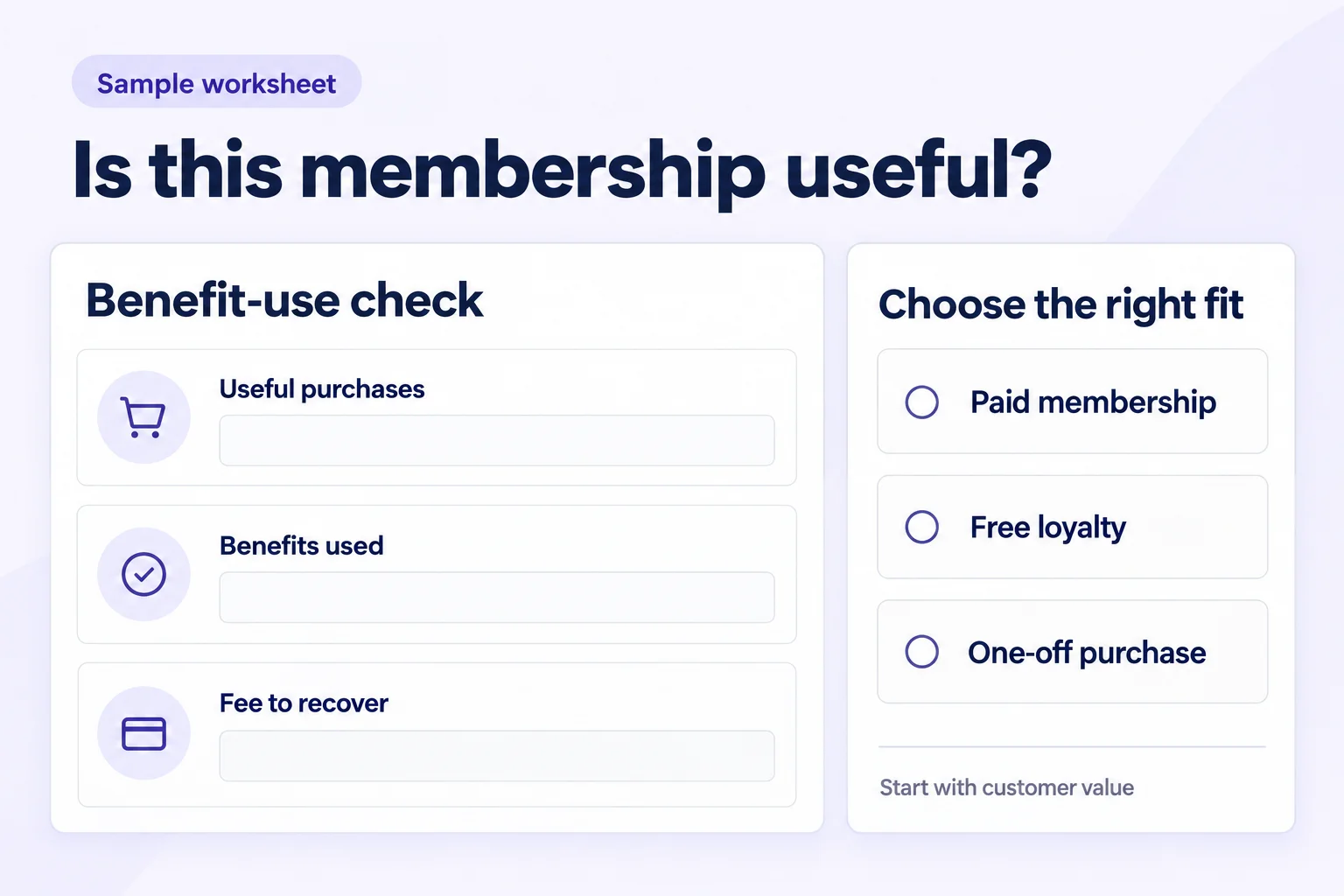
List the purchases a shopper already expects to make over a relevant period. For each, record the benefit they could actually use, the saving beyond public offers and anything that prevents redemption. Include periods with no purchase.
This fictional three-month diary assumes a $10 monthly fee and a 10% discount on eligible product spend. The amounts exclude tax, shipping and other benefits; no competing public discount applies.
On small screens, scroll the table horizontally to see every column.
| Month | Eligible spend before discount | Discount used | Membership fee |
|---|---|---|---|
| 1 | $80 | $8 | $10 |
| 2 | $0 | $0 | $10 |
| 3 | $120 | $12 | $10 |
| Total | $200 | $20 | $30 |
The shopper pays $30 in fees and uses $20 in discounts, leaving them $10 worse off on this discount-only comparison. Break-even requires $30 ÷ 10% = $300 in eligible purchases during the same period. That is a test of the offer, not a reason to persuade the customer to buy an unnecessary extra $100.
If the same shopper naturally spends $600, the discount is $60 and savings after fees are $30. The merchant must still fund the discount and operating costs. Higher customer savings are not proof of higher merchant profit.
For access or content benefits, describe the experience rather than assigning an invented cash value. Record unused credit separately from redeemed credit. The membership benefits examples compare frequent, occasional and hobby shoppers; the pricing guide helps assess the fee.
Choose paid membership, free loyalty or a one-off purchase
- Is there a recurring customer need? If purchases are rare or unpredictable, start with a straightforward one-off purchase. You may not need to change the offer.
- Is there additional value worth paying for? If not, consider free loyalty when rewards fit the business. Free membership still has benefit and operating costs for the merchant.
- Can the intended shopper use the value without changing sensible buying habits? If the answer is unclear, revise the benefit, audience or price before introducing a fee.
- Can the business deliver and fund the promise? If yes, test a focused paid membership. If not, simplify it or keep the existing purchase model.
These options can serve different customer groups. A paid club may suit frequent buyers while occasional customers continue to shop normally. Make the choice understandable and show the fee, benefit limits and how members manage their membership before they join.
Compare paid and free loyalty models. If you are considering regular product deliveries, first distinguish them from membership benefits versus product subscriptions.
Reduce the work involved in getting value
Choose one primary benefit that is easy to explain. Put the fee, eligible purchases and limits beside it. Avoid making shoppers decode several currencies, tiers and deadlines before they know whether joining helps.
- Show the first useful action. Explain how to sign in, find benefits and use the core perk. Follow the member onboarding checklist.
- Match reminders to the purchase cycle. A useful reminder should help someone use an expected benefit, not pressure them into unnecessary orders.
- Describe management options accurately. Explain the cancellation and renewal process your program actually supports. Do not advertise pausing, skipping or downgrading unless the configured experience supports it.
- Make existing free value clear. If public orders already qualify for free shipping, explain when the member benefit makes a difference.
An annual fee changes the payment schedule; it does not fix an offer that customers rarely use. Test the benefit's relevance before trying to solve hesitation with a longer commitment.
Test the offer before expanding it
Ask a small group of suitable shoppers to explain the offer in their own words: what they pay, what they receive, which purchase qualifies and what they would do first. Treat confusion as a design problem to resolve before adding more perks.
For a pilot, choose a review period that includes realistic opportunities to use the benefit. Record joining, first benefit use, repeat usage, support questions, cancellation reasons and merchant costs. Distinguish members who had no opportunity to use a benefit from those who tried and could not.
Include low-usage and no-change-in-purchasing scenarios in the budget. Members may already be your most frequent shoppers, so their higher spending alone does not show that membership caused growth. A pilot should help you improve, narrow or stop an offer as well as expand it.
Use the business-case workbook to organize assumptions. This is a planning exercise, not a forecast of retention or revenue.
Where Memberply fits
Memberply helps Shopify merchants configure paid or free membership tiers with benefits such as store credit, member discounts, free shipping and exclusive access. Start with the available benefit types, then confirm the eligibility, limits and customer-account experience for the offer you want to test.
The app cannot make an unsuitable membership valuable. If shoppers do not have a recurring need or enough usable benefit, choose a simpler offer before investing in setup.
Subscription fatigue questions
What is subscription fatigue?
Subscription fatigue is feeling tired of managing or paying for recurring services. For a retail membership, the concern may be that the fee, effort or unused benefits outweigh the value the shopper expects.
Can a paid membership make subscription fatigue worse?
Yes. Another recurring fee can add to the problem if benefits overlap with free offers, customers rarely shop or the value is hard to use. A free loyalty program or one-off purchase may be more suitable.
Is subscription fatigue the same as a failed payment?
No. A failed payment is a billing event. It does not tell you whether someone values the membership. Review payment issues separately from affordability, benefit use and cancellation feedback.
How can I test a membership offer before launching?
Describe one core benefit and its limits, compare the fee with realistic usage, and ask suitable shoppers to explain the offer back to you. Then pilot the joining and benefit-use journey and review customer value alongside merchant costs.
Does Memberply prevent subscription fatigue?
No app can guarantee that customers want another membership. Memberply can help Shopify merchants configure paid or free tiers and benefits, but the offer, cost and customer fit still need testing.