
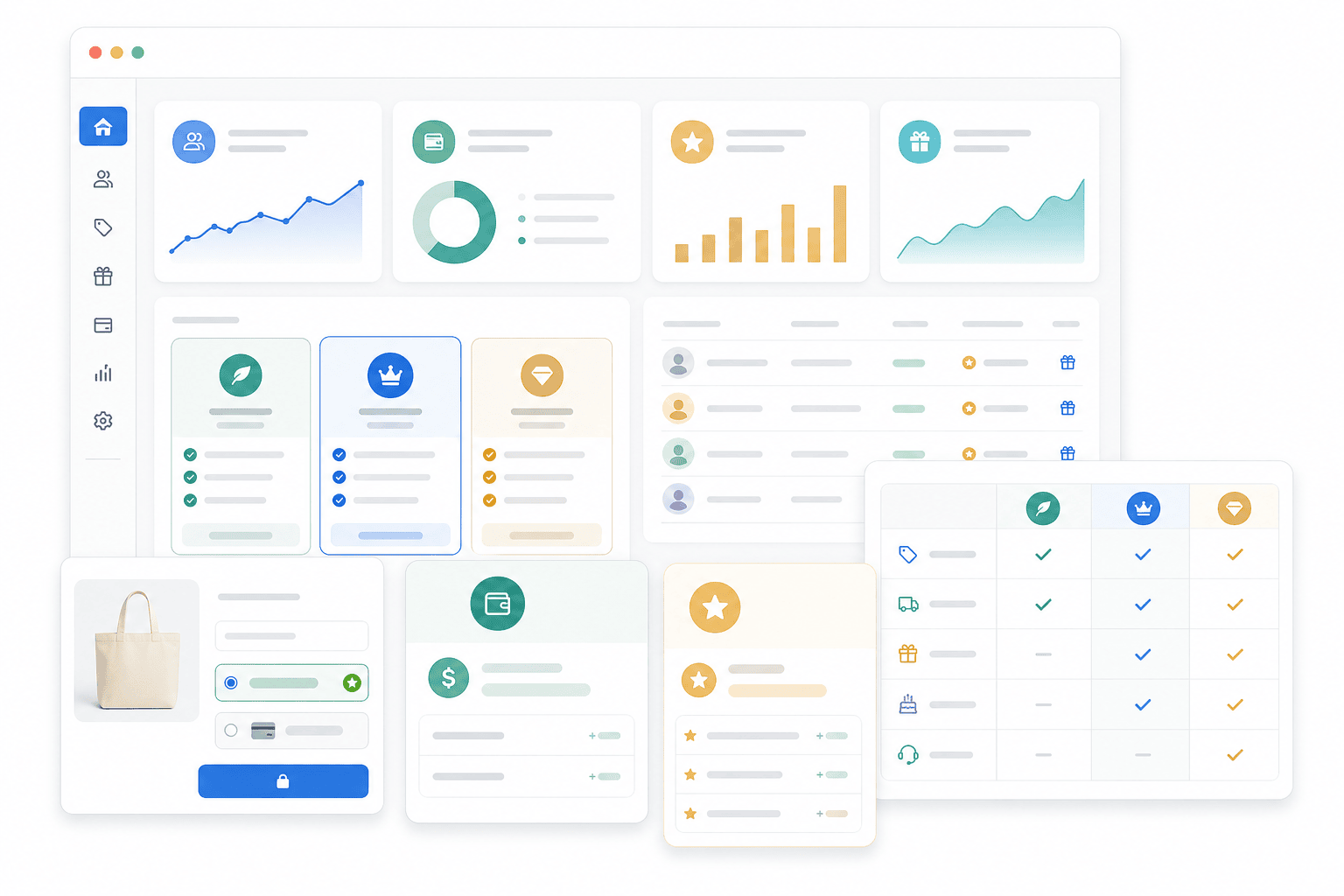
What is a paid loyalty program?
A paid loyalty program charges customers a membership fee in exchange for defined benefits. Those benefits might include member discounts, free shipping on eligible orders, recurring store credit, or exclusive products. The fee may be monthly, annual, or a one-time payment, depending on the offer.
Sometimes called a premium loyalty program, it needs a clear answer to a customer’s question: “What will I actually use that makes joining worthwhile?” A long list of perks is less useful than a specific benefit that fits how the customer shops.
For example, frequent buyers may value shipping savings, while a replenishment customer may prefer predictable credit. Access to a restricted collection may suit enthusiasts who care more about availability than a percentage discount. Memberply combines membership tiers with configurable benefits so the offer can match the audience.
Paid vs free loyalty programs
| Decision | Free loyalty program | Paid loyalty program |
|---|---|---|
| Joining | No membership fee; customers may enrol or qualify through activity. | Customers pay for the benefits described in the offer. |
| Customer value | Often builds through purchases, points, or status. | Needs to justify the fee through useful access, savings, or rewards. |
| Merchant costs | Rewards and operating costs without membership-fee revenue. | Rewards and operating costs, offset partly by membership fees. |
| Useful audience | Customers exploring the store or building a purchase habit. | Customers whose expected use makes the paid benefits worthwhile. |
| What to measure | Participation, repeat purchasing, and reward costs. | Those measures plus paid conversion, renewals, and cancellations. |
Free programs can offer immediate benefits, and paid programs can include earned rewards. Payment and reward mechanics are separate choices. You can offer a free entry tier and a paid option, but make the upgrade value easy to explain.
A spend-based tier is also different from a paid membership. A customer might qualify for a level through eligible purchases without paying a fee. See the tiered loyalty guide for annual and lifetime qualification rules.
Four paid loyalty program examples for Shopify stores
These are fictional planning examples, not real merchant results or recommended prices. The amounts illustrate how fees, benefits, and customer habits fit together.
| Program | Example fee and benefits | Who might find it useful? |
|---|---|---|
| Beauty replenishment club | $10 per month with a $5 monthly loyalty drop and 5% off eligible products. | Regular buyers who can use the credit and savings each month. |
| Coffee shipping club | $48 per year with free shipping on qualifying orders. | Repeat buyers whose eligible shipping savings exceed the fee. |
| Homewares VIP program | $60 per year with 10% off eligible products and access to a restricted collection. | Customers planning enough eligible purchases to recover the fee. |
| Fee-to-credit membership | $20 per month converted into $20 store credit for future purchases. | Customers who expect to return regularly and understand the credit conditions. |
In the beauty example, a customer making $100 in eligible purchases receives $5 in discounts plus a $5 credit grant. That reaches the $10 fee in nominal benefit value only if the credit is actually used. Timing, exclusions, and expiry matter.
In the fee-to-credit example, the fee funds future spending value. It is not a cash refund, and the fee is not pure profit. Memberply lets you choose whether the first membership payment earns credit or whether credit starts from the second charge.
Build the relevant benefits using loyalty drops, free shipping, member discounts, and fee-to-store-credit. Start with one understandable offer rather than enabling every benefit.
Calculate when the membership pays off for the customer
For a simple discount-only offer, divide the membership fee by the discount rate. Use the same period for the fee and expected purchases, and count only eligible spending.
For shipping, divide the fee by the shipping charge the customer would otherwise pay on qualifying orders. A $48 annual fee with $6 saved per eligible order needs eight orders to recover the fee. Do not count orders that would already qualify for public free shipping.
Store credit needs a separate usage assumption. A $5 monthly grant has $60 in annual face value across 12 grants, but a customer who redeems only half uses $30. Do not present unused credit, points, or speculative exclusive access as guaranteed cash savings. The store credit guide explains earning and redemption.
Check the merchant economics before setting the fee
Customer break-even and merchant profitability are different calculations. Include product costs, shipping subsidies, redeemed credit, payment fees, app costs, and support. Compare the program with what the same customers would plausibly have purchased without it.
| Item | Assumption |
|---|---|
| Membership revenue | $60 |
| Product sales before member discount | $600 |
| 10% member discount | −$60 |
| Product and fulfilment costs | −$360 |
| Contribution before other costs | $240: $60 + $600 − $60 − $360 |
If the customer would have bought the same $600 of products without joining, the comparable contribution would also be $240 before other costs. In this simplified example, the fee only offsets the discount. Extra support costs or shipping benefits could make the program worse unless purchasing behaviour changes.
Model lower, expected, and higher benefit usage. Heavy users can redeem much more than the average member, particularly with shipping or credit. Do not assume unused rewards or increased spending will make an otherwise uneconomic offer work.
Use the membership pricing guide and loyalty ROI calculator to explore assumptions. These calculations are planning tools, not a revenue forecast.
When a paid loyalty program may be unsuitable
- Purchases are infrequent. If most customers buy once, recurring benefits may not justify another fee.
- The paid benefits duplicate public offers. Free shipping or discounts that everyone already receives provide little extra value.
- Margins cannot support realistic usage. Reduce or narrow the benefits before asking members to pay.
- The rules are hard to explain. Too many exclusions or unclear credit conditions can make the advertised value difficult to use.
- Your team cannot support the experience. Customers need clear access, renewal information, and help with missing benefits.
A free program, a simpler member discount, or a targeted retention offer may be a better starting point. Paid loyalty is a commercial choice, not a requirement for every store.
Decide who the paid offer is for before a pilot
Separate shoppers who could recover the fee through purchases they already expect to make from shoppers who would need an unrealistic change in habits. Evaluate the first group's benefit costs even if their order frequency stays unchanged.
| Evidence from your store | Decision to test |
|---|---|
| Repeat buyers already pay for delivery several times a year. | Compare a paid shipping bundle with a free credit reward; cost frequent deliveries as well as average use. |
| Most buyers place one low-value order and rarely return. | Test the reason for a second purchase before asking for a recurring commitment. |
| Frequent shoppers already qualify for similar discounts. | Offer a distinct benefit or improve the free program; do not count existing savings as new paid value. |
Set a pilot audience, cost ceiling and review date before promotion. Compare net fees and incremental contribution with benefit and operating costs. A high join rate alone is not a reason to expand. If paid loyalty is a poor fit, compare the other types of loyalty programs.
If the main aim is to recognise existing high-value customers, compare earned VIP status with paid membership before adding a fee.
How to choose a Shopify app for paid loyalty
Start with the promise customers are paying for, then test whether the app can deliver it. A points program, paid membership and product subscription solve different needs. A merchant wanting recurring access to perks should check membership billing and benefit eligibility together.
| Requirement | What to verify in a trial |
|---|---|
| Membership billing | Required billing interval, joining flow, renewal and cancellation behavior. |
| Benefit delivery | When credit or discounts become available, which purchases qualify and what ends when membership ends. |
| Customer accounts | Member access to benefits and membership management in the account experience your store uses. |
| Online and POS | Customer identification, eligible rewards and redemption in each sales channel you need. |
| Total cost | App subscription, usage limits, reward funding, delivery, payment charges and any custom work. |
| Existing members | Member records, billing agreements and outstanding rewards. Confirm what transfers before cancelling another app. |
Use our Shopify membership app comparison for paid membership options, or the loyalty app comparison for broader points and rewards requirements.
Already using another membership app? Review the Inveterate comparison or Bold Memberships comparison for pricing and switching checks before changing your live program.
When Memberply fits the paid loyalty offer
Memberply fits Shopify stores selling access to configurable member benefits: member-only shipping, member discounts, store credit rewards and exclusive access. Start with one offer your repeat customers can use, then validate its conditions.
Growth costs US$49/month with unlimited members, a 14-day free trial and no Memberply percentage fee on membership revenue. Your benefit budget, Shopify and payment-provider charges are separate; custom enterprise work needs its own scope and quote. Check pricing before choosing a plan.
A recurring shipment of merchandise needs a product-subscription workflow; membership billing alone is not that workflow. If your priority is a complex referral program, a particular enterprise integration or migrating existing payment agreements, confirm those exact requirements before selecting an app.
Check Shopify POS loyalty separately
An online checkout test does not prove the in-store journey. Use the Shopify POS integration guide to check staff identification of members, supported benefits and redemption. Do not promise that every online perk applies identically in POS.
Define a trial that can pass or fail
Create one test tier, join with a test customer, confirm the intended reward and use it on an eligible purchase. Repeat with an ineligible cart and check how the member sees benefits in the member portal. Verify billing and cancellation settings before accepting real members. Record the actual costs and any unresolved integration requirements.
How to set up a paid loyalty program on Shopify
Define the offer and create the tier
Choose the intended customer, fee, payment frequency, and benefits. Memberply supports recurring and one-time-payment tiers. Make the billing terms and benefit conditions clear before customers join.
Configure and cost the benefits
Open Benefits, find the tier, and select Edit Benefits. Set the discount or credit amounts and eligibility. For free shipping, review minimum requirements, supported countries, and product exclusions. For credit, choose validity or No Expiry.
Enable membership purchasing
For recurring tiers, enable the Memberply Membership selling plans app embed in your theme. Add the Memberply Subscription Details block to the membership product page. Follow the membership checkout setup instructions.
Connect new customer accounts
Use Shopify’s new customer accounts and add the Memberply benefits page to the accounts menu. Enable Store credit if the program uses native credit rewards. Follow the member benefits setup guide.
Explain and test the full journey
Use a membership landing page to explain the offer. In a development or staging store with test payments, check purchase, account access, eligible and excluded products, reward delivery, and membership management. Test recurring billing events for recurring tiers before launch.
Measure the program after launch
Track paid joins, the share of members using a benefit, repeat orders, renewal and cancellation rates, and the cost of rewards. Separate credit issued from credit redeemed. Compare groups over the same period and account for the fact that enthusiastic customers may be more likely to join in the first place.
If members join but rarely use benefits, improve the account experience and onboarding. If benefits are used heavily but contribution is weak, review the offer economics before expanding promotion. If customers cancel after one purchase, investigate whether the recurring promise matches their shopping habits.
These are measures to assemble from your available records, not a claim that Memberply provides one report containing every calculation. Review membership retention strategies once the offer and access experience are working.
Paid loyalty program FAQs
What is a paid loyalty program?
A paid loyalty program charges a membership fee for defined benefits such as discounts, free shipping, store credit, or exclusive access. The offer should explain the fee, eligibility, and how customers use the benefits.
How is paid loyalty different from free loyalty?
Free programs do not charge a joining fee. Paid programs charge for a defined benefit bundle. Either model can include points, immediate perks, or rewards earned through purchases.
How much should a paid loyalty program cost?
Set the fee using expected customer value and realistic benefit costs. For example, a $60 annual fee with a 10% eligible-product discount needs $600 of eligible annual purchases to recover the fee through discounts alone.
Can I combine membership fees with store credit?
Yes. Memberply supports credit benefits including loyalty drops and fee-to-store-credit. Explain when credit is earned, how it is redeemed, and its expiry. Issued credit should not be treated as pure profit or a cash refund.
Can a Shopify paid loyalty program use monthly or annual billing?
Yes. Memberply supports recurring membership tiers as well as one-time-payment tiers. Choose a billing model that matches the offer and configure the required storefront purchasing setup.
Which customer accounts should members use?
Use Shopify’s new customer accounts and add the Memberply benefits page to the accounts menu. Enable Store credit when your program uses native credit rewards.
When should I choose a free program instead?
Consider a free program when customers shop infrequently, the paid benefits do not add enough value, or realistic benefit usage makes the offer uneconomic. Test a simpler benefit before adding a fee.
Do paid loyalty programs guarantee more repeat sales?
No. Results depend on the offer, audience, costs, and customer experience. Measure repeat purchasing and contribution against a suitable baseline instead of assuming membership fees or reward redemption prove growth.