
What is a loyalty program strategy?
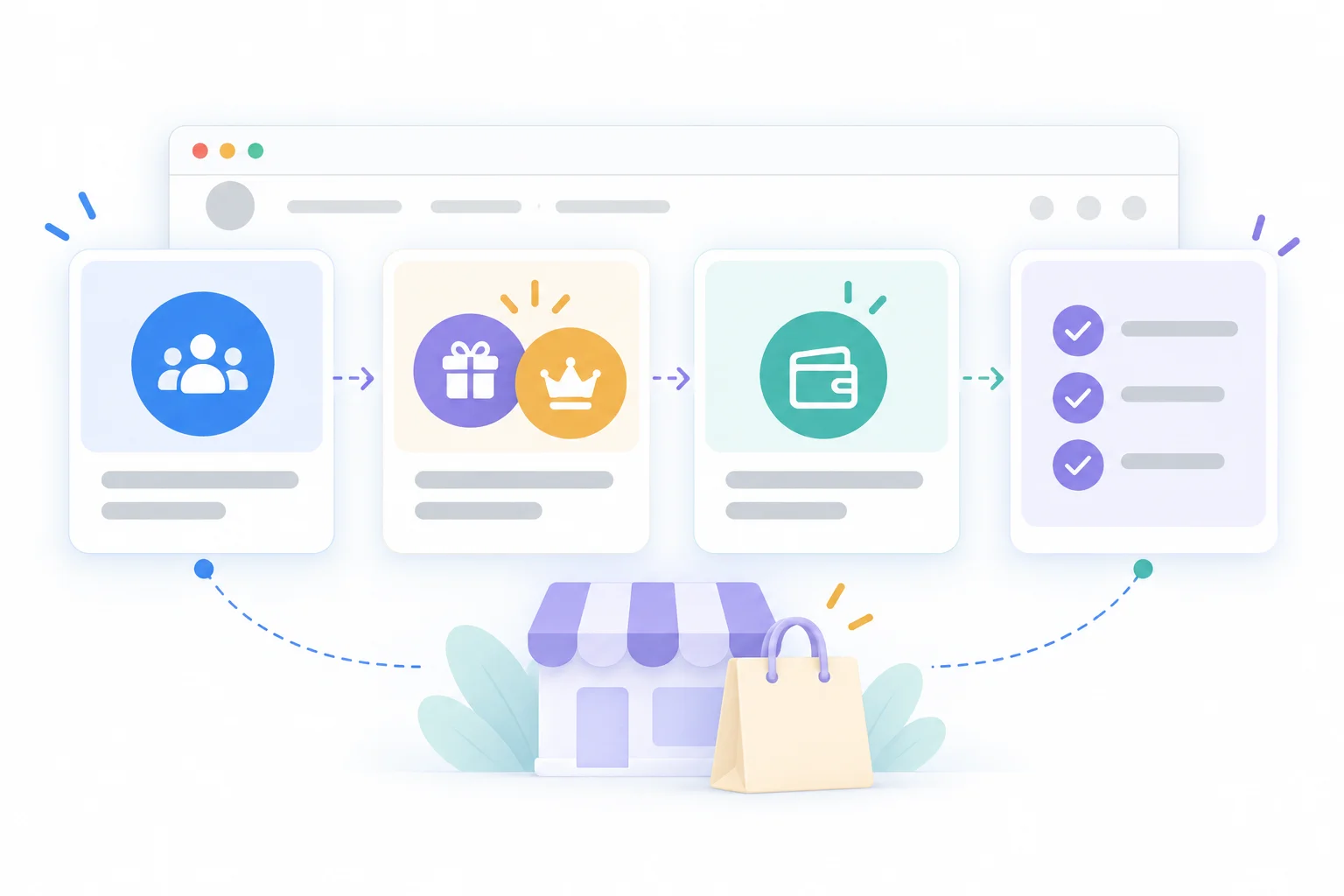
A loyalty program strategy is a plan for who your program serves, what behaviour it encourages, which benefits it offers, what those benefits cost and how you will evaluate the result. The practical sequence is: choose an audience, identify a useful next action, select a reward, set its rules, test delivery and measure contribution.
A benefit is one part of the strategy. Points, credit and VIP access are mechanisms; they do not explain why a customer would return or whether another order would be profitable. Shopify’s loyalty overview describes several program models and the importance of understandable, attainable rewards.
This guide focuses on planning and running the program. For inspiration, explore our loyalty program ideas. For broader service and purchasing problems, use the customer retention examples.
1. Choose an audience and one objective
Start with an observable customer problem. A replenishment store might want more first-time buyers to place a second order. A collection-led brand might want existing customers to discover its next launch. A paid membership might need new members to use their first benefit.
Define the eligible group before launching. Record its existing purchase frequency, time between orders, order contribution and returns. Choose a measurement window that reflects the product. A short window suitable for consumables may tell you little about an occasional jewelry buyer.
Illustrative objective: test whether a simple credit reward increases contribution per eligible first-time customer over the next 90 days. The 90-day window is an example, not a benchmark. Replace it with a period supported by your own buying cycle.
Use customer segmentation examples to define inclusion and exclusion rules. If delivery failures or unresolved support issues are the main reason customers leave, address those before adding rewards.
2. Choose a reward model that fits
| Model | Useful situation | Main tradeoff |
|---|---|---|
| Purchase points | Customers buy often enough to earn a meaningful reward. | Explain earning and conversion without making redemption feel distant. |
| Store credit | Customers can use a visible balance on a later purchase. | Issued credit is an obligation to plan for, not proof of another sale. |
| VIP or exclusive access | Customers value a restricted collection or experience. | The benefit needs real value and a reliable access process. |
| Member discounts | Eligible-product savings are easy to understand. | Discounts reduce contribution on purchases that may have happened anyway. |
| Paid membership | A defined group can regularly use a valuable benefit bundle. | The fee must make sense for the customer and cover realistic benefit usage. |
Start with one primary benefit. Combining points, credit, shipping and a paid fee can make both the offer and its cost harder to understand. A free entry tier with a paid upgrade can be tested later if the additional value is clear.
Compare the free and paid models, spend-tier rules and store credit options before choosing.
3. Budget rewards before setting the rules
Calculate benefit cost using the same period and customer group as your objective. Include discounts, redeemed credit, shipping subsidies, service delivery, software and staff time. Track credit issued, redeemed and outstanding separately; do not treat unredeemed balances as an automatic gain.
Translate points into a customer value
With one point earned per $1 spent and 20 points required for $1 of credit, a $100 eligible purchase earns 100 points, redeemable for $5. The nominal reward rate is 5%: points earned per dollar divided by points required per dollar of reward. The actual cost also depends on exclusions, redemption and the economics of later orders.
Worked pilot budget
Fictional planning example: 200 eligible customers receive an offer for $5 credit. If all qualify, the maximum face value issued is $1,000. At an assumed 60% redemption rate, $600 would be redeemed. Budget another $200 for software and operating costs allocated to the pilot, giving $800 in modelled cost. These are assumptions, not expected Memberply results.
If each genuinely additional order contributes $20 after product and other variable costs but before this reward, the pilot needs 40 additional orders to cover $800. Do not subtract redeemed credit again inside that $20, or count the same reward cost twice. If all credit is redeemed, the modelled cost becomes $1,200 and the threshold rises to 60 additional orders.
The remaining credit in the lower-redemption scenario may still be used later, so that scenario is not a final lifetime result. A cash-flow plan should allow for the full issuance and applicable terms. Use the loyalty ROI calculator and discount profit calculator with your own inputs.
4. Write rules that customers and staff can explain
- Eligibility: define who can join, which purchases count and any product or collection exclusions.
- Earning and redemption: explain the value, when it becomes usable, any threshold and how members find it.
- Expiry and cancellation: distinguish membership access from reward expiry and explain the effect of ending a paid tier.
- Returns and promotions: state the policy, then verify refund behaviour and discount combinations in your actual setup.
- Ownership and channels: explain whose account owns a reward and whether it works online, at POS or both.
Write a plain-language example using a realistic basket before writing a long terms page. If staff cannot explain what a customer gets from that basket, simplify the offer. Test the rules in the app before advertising them.
5. Configure and test the Shopify journey
- Create the appropriate tier. Memberply supports free, one-time and recurring paid membership tiers. Review the fee and billing frequency before publishing because those settings are locked afterward. Follow the tier creation instructions.
- Enable the chosen benefit. In Benefits, open Edit Benefits for the tier. Configure points and conversion, member discounts, credit or access as appropriate. See the reward points instructions and discount exclusions.
- Connect the storefront. Recurring tiers need the Memberply Membership selling plans app embed and the Memberply Subscription Details block. Follow the checkout setup. Restricted collections also need the theme and checkout access protection.
- Connect new customer accounts. Add the Memberply benefits page to the accounts menu. Enable Store credit if rewards use native credit. Follow the account setup guide. If selling in person, separately configure and test Shopify POS.
- Test before inviting customers. Use a development or staging store to check joining, sign-in, benefit use, exclusions, mixed carts, refunds and cancellation. For paid recurring tiers, test renewals as well as the first order. Document what staff should do if a reward is missing.
6. Launch a focused pilot
Publish an offer page that states who the program is for, what members receive, the fee if any and the important limitations. Link directly to the joining flow and explain where benefits appear afterward. Use membership landing page examples for the page structure.
Choose a manageable pilot audience and name an owner for support, cost monitoring and review. A simple launch sequence is an invitation, a joining confirmation and help using the first benefit. Configure any additional marketing in the appropriate email platform and verify the data and consent rules. Do not assume every reward balance is automatically available to every integration.
Set a cost ceiling and review date before launch. If redemption fails, pause promotion and fix the customer journey. If usage is healthy but contribution is weak, revisit the economics before increasing reach. Honour benefits already promised when changing an offer.
Match follow-up to the customer’s current stage
Plan purchase follow-up and membership follow-up separately. A customer can be an active member who has not ordered recently, or a repeat buyer who has never joined. The illustrative rules below prevent those groups from receiving the same offer.
| Audience | Useful next message | Exclusion or stop rule |
|---|---|---|
| First-time buyer | Help them use the purchase and understand a relevant joining offer. | Stop the first-purchase sequence when another completed purchase is recorded. |
| Repeat buyer | Recognise the relationship and suggest a useful next product or benefit. | Exclude products already purchased and suppress duplicate acquisition offers. |
| New active member | Explain where to find and use the first eligible benefit. | End activation reminders once verified benefit use is recorded, if your data supports that condition. |
| Eligible VIP member | Explain existing access and service benefits before adding another discount. | Recheck current tier and eligibility before each benefit-specific message. |
| Lapsed buyer or ended membership | Use purchase timing for a buying lapse and membership status for a rejoining offer. | Exit purchase win-back on a relevant order and membership win-back on reactivation. |
Write down which flow takes priority when audiences overlap, and apply consent, opt-out and unresolved-service exclusions before sending promotions. Verify each trigger and exit with a test profile. A purchase is not a membership renewal, and a renewal is not proof that a product recommendation was relevant. Use the customer lifecycle guide for the wider communication plan.
Configure these flows in your email platform. Memberply’s Klaviyo integration provides membership status and tier properties; it does not create campaigns or change marketing consent. Verify order and product data through your commerce integration, and verify a separate data source before using reward balances or benefit-use events as conditions.
7. Measure contribution, not just member revenue
| Measure | How to use it |
|---|---|
| Enrolment and first benefit use | Identify whether customers understand and can use the offer. |
| Repeat purchase rate | Count eligible customers making another purchase within the defined window. |
| Contribution per eligible customer | Include customers who do not purchase again, and subtract the relevant reward and operating costs. |
| Credit issued, redeemed and outstanding | Monitor reward usage and future cost exposure separately. |
| Paid renewals and cancellations | Evaluate ongoing value for paid tiers without assuming membership fees are pure profit. |
Use a suitable baseline or holdout group where practical. Assign eligible customers before the offer when your experiment design permits it; comparing people who volunteered to join with everyone else introduces selection differences. Allow both groups the same observation window and account for returns.
A 30% repeat purchase rate versus 25% is a five-percentage-point difference, or a 20% relative increase. Neither figure alone establishes causation or profitability. Check sample size, seasonal effects, contribution and the uncertainty before scaling. Avoid claiming success from enrolment or member revenue alone.
A one-page loyalty strategy template
| Decision | Write down |
|---|---|
| Audience | Who qualifies, who is excluded and why this group needs the benefit. |
| Objective and baseline | The next useful customer action, current behaviour and measurement window. |
| Offer | One primary benefit, its customer value and whether membership is free or paid. |
| Economics | Expected and heavy-use costs, reward exposure and additional contribution needed. |
| Rules | Eligible purchases, earning, redemption, expiry, returns and cancellation. |
| Delivery | App settings, account access, staff workflow and test cases. |
| Follow-up | Audience, message, verified data source, consent, flow priority and exit condition. |
| Pilot | Audience size, owner, review date, cost ceiling and comparison method. |
| Decision | Conditions for continuing, changing the offer or stopping promotion. |
Keep the first version small enough that you can explain it in a staff briefing. Use the industry guides to adapt it: fashion for collection access and sportswear for seasonal purchasing, pet supplies for replenishment and shipping, and jewelry for gifting and occasional purchases, and beauty for refill rewards and product discovery. For beans and café customers, use the coffee loyalty and membership guide. For mixed food baskets and delivery rules, see the grocery loyalty guide.
Loyalty program strategy questions
What is a loyalty program strategy?
A loyalty program strategy defines the customer group, behaviour you want to encourage, reward, cost limits, delivery process and measurement plan. It connects the offer to a business objective before you configure points or membership tiers.
Which loyalty program model should a Shopify store choose?
Choose based on customer purchase frequency, the value of the benefit and your cost to provide it. Points or credit may suit repeat purchases, access may suit desirable collections, and a paid membership needs a benefit bundle that customers can use enough to justify the fee.
How do I calculate the value of reward points?
Divide the points earned per currency unit spent by the points needed for one currency unit of reward. For example, one point per dollar and 20 points per dollar of credit represents 5% nominal reward value before exclusions and redemption behaviour.
How much should a loyalty program cost?
There is no universal budget. Include discounts, redeemed rewards, shipping subsidies, services, software and operating costs. Model expected and heavier benefit use, then compare the cost with incremental contribution rather than total member revenue.
Can I launch a free loyalty program with Memberply?
Memberply supports free membership tiers as well as one-time and recurring paid tiers. A free customer membership does not mean your software, rewards or operating costs are free.
How do I know whether a loyalty program is working?
Track benefit use and contribution over a purchase window that fits the audience. Compare eligible groups using a suitable baseline or holdout where practical. Member enrolment and higher spending by members alone do not prove the program caused growth.
Is loyalty strategy the same as customer retention?
Loyalty program strategy concerns the design and operation of a rewards or membership offer. Customer retention is broader and also includes product quality, service, delivery and the reasons customers choose to return.