
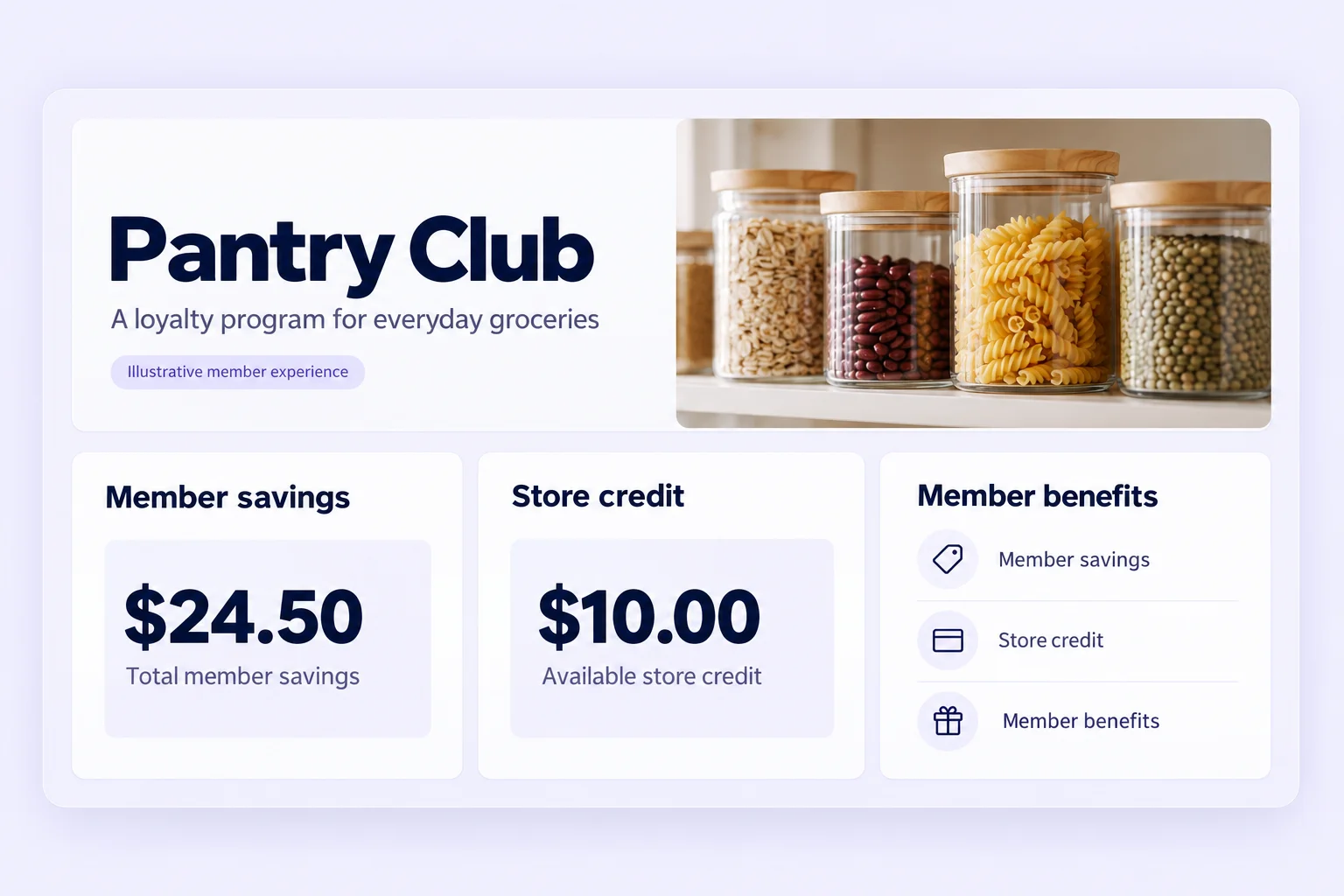
What should a grocery loyalty program do?
A grocery loyalty program gives food shoppers a reason to return through benefits such as member prices, purchase points, credit or eligible delivery savings. A grocery membership packages those benefits into a free or paid tier. Its value should be understandable before checkout.
Start with the shopping mission: a weekly basket, an occasional pantry refill or a specialty-food purchase. A program for frequent local deliveries needs different rules from one for shelf-stable parcels. This guide focuses on Shopify food and grocery merchants rather than restaurant visits or a consumer ranking of supermarket cards.
Grocery loyalty program examples
| Program | Model | Merchant lesson |
|---|---|---|
| Kroger rewards | Kroger describes earning points and redeeming them for groceries or fuel, subject to program rules. | Make the reward choice and redemption process explicit; do not leave points as an unexplained number. |
| Thrive Market | A paid membership for shopping benefits, with different shipping thresholds for grocery and frozen boxes. | Membership does not have to mean unconditional delivery on every basket. |
| Guzel Ada Gida with Memberply | Our customer story describes a food membership with member discounts and free shipping. | A focused offer can be easier to explain and operate than a long list of perks. |
See Kroger’s rewards announcement, Thrive Market’s membership explanation and its shipping rules. These are independent examples, not claimed Memberply implementations or a promise that every mechanic is supported.
Read the Guzel Ada Gida customer story for the Memberply example. It illustrates the offer without establishing an expected revenue or retention increase for another merchant.
Choose free grocery rewards or a paid food membership
| Model | Possible fit | Decision before launch |
|---|---|---|
| Free points or credit club | Occasional shoppers or customers still exploring the range. | Can the customer reach a useful reward through ordinary eligible purchases? |
| Paid savings membership | Frequent buyers who can use the benefits through the membership term. | Can customers recover the fee without buying things they do not need? |
| Delivery-focused membership | An audience ordering within delivery routes you can serve profitably. | Which baskets, destinations and delivery methods qualify? |
| Recurring food box | Customers explicitly choosing scheduled products or produce boxes. | Configure recurring product orders and fulfilment separately from membership benefits. |
Memberply supports free and paid tiers. A free tier still has software and benefit costs for the merchant. For paid tiers, show fees, renewal, cancellation and the main exclusions before joining. Use the membership versus subscription guide if the offer includes recurring food deliveries.
Calculate basket contribution before offering rewards
Fictional $80 grocery basket: subtract $52 of product costs, $6 of picking, packing and payment costs, and an $8 delivery subsidy. That leaves $14 before rewards. A 5% member discount costs $4, leaving $10 before software, support, refunds and other overhead.
For a fictional $35 top-up basket, $23 of product costs, $5 of handling and the same $8 delivery subsidy already leave a $1 loss. A 5% discount increases that loss to $2.75. More orders would not solve this margin problem without changing the basket, fulfilment cost or offer.
Suppose a customer adds $20 of eligible pantry products to qualify for delivery. At an illustrative 30% product contribution margin, those items add $6 before extra handling. If qualification introduces an $8 delivery subsidy, the larger basket alone has not covered it. Model the change in contribution, not just average order value.
A $60 annual fee with only a 5% member discount requires $1,200 of eligible purchases for the customer to recover the fee through that saving. Excluded products do not count. Model frequent delivery users separately, and include points or credit alongside discounts without counting the same credit cost at both issuance and redemption.
Use the membership discount profit calculator and average order value calculator with your own figures. These examples are planning illustrations, not recommended prices or customer results.
Define eligible baskets and delivery rules
| Decision | Grocery example | What to verify |
|---|---|---|
| Eligible spend | Exclude a chilled collection from a pantry shipping offer. | Excluded products do not count toward Memberply’s free shipping minimum. |
| Discount exclusions | Exclude low-margin staples, gift cards or clearance bundles if required by the offer. | Configure member-discount exclusions separately from free-shipping exclusions. |
| Fulfilment costs | Frozen goods may need different packaging and handling from pantry items. | Product exclusions do not automatically create separate delivery charges or parcels. |
| Availability | Local delivery may depend on postcode, capacity and ordering cutoffs. | A membership benefit does not reserve a slot or manage routing. |
| Order changes | An unavailable item is removed or substituted after the order. | Check the actual reward, discount and refund behaviour, and explain the customer outcome. |
Illustrative threshold: with a $60 eligible-purchase minimum, a cart containing $50 of eligible pantry products and $20 of excluded frozen products still has only $50 of qualifying spend. Do not advertise that every $70 basket qualifies. Test the configured treatment of promotions, tax and shipping rather than deriving eligibility from the displayed cart total.
Do not promise that a product exclusion guarantees a separate shipping charge on that item in a mixed basket. Validate your shipping profiles, delivery methods and checkout result. Keep expiry, stock availability and substitutions in your store’s fulfilment process rather than treating loyalty as inventory management.
Set up grocery membership on Shopify
- Choose an audience and primary benefit. Start with a defined buying pattern and a contribution target. Write the offer and exclusions first.
- Create the tier. Set a free or paid membership and the intended billing structure. Keep product subscriptions separate.
- Configure benefits. Open Benefits in Memberply and edit the tier. Set discounts, points conversion and free-shipping requirements as applicable. Apply product and collection exclusions to each relevant benefit.
- Enable account access. Use Shopify’s new customer accounts and add the Memberply benefits page to the account menu. Enable Store credit for native credit or points redeemed for credit.
- Configure the channels you promise. Test online orders and Shopify POS if applicable. Enable Store Credit as a POS payment method before offering native credit redemption there.
- Publish and pilot. Link the offer, joining flow and account benefits. Train staff to explain qualifying baskets and order changes.
Follow the free shipping setup, store credit guide and POS integration documentation for the relevant configuration.
Plan useful repeat-order messages
| Audience | Useful follow-up | Stop or exclude when |
|---|---|---|
| First completed order | Ask whether the delivery arrived as expected and show how to find eligible rewards. | An unresolved missing-item, damage or substitution issue needs support. |
| Pantry refill customer | Base a reminder on observed reorder intervals for that product and pack size. | A reorder is recorded or an upcoming recurring delivery makes the reminder redundant. |
| Buyer of a recipe ingredient | Suggest a relevant complementary item or recipe using verified product information. | The suggested product is already purchased, unavailable or inconsistent with preferences the customer supplied. |
| Frequent eligible member | Recognise repeat purchasing and explain an existing benefit they qualify for. | Their tier or delivery eligibility has changed; do not promise access from past status alone. |
These fictional workflows draw on purchase-cycle and relevant cross-sell principles. A bulk pantry purchase is different from a weekly fresh-food basket. Do not infer an allergy, diet or household consumption rate from membership status. Let customers choose reminder preferences and avoid sending a fresh-food offer outside the area you can serve.
Configure campaigns in your email platform with consent and verified order data. Memberply’s Klaviyo integration provides membership status and tier properties; it does not create campaigns or change consent. Verify separate sources for delivery status, subscriptions and reward balances. See the cross-sell examples for message planning.
Test real grocery baskets before launch
- Thresholds: test just below, at and above the minimum with eligible and excluded products.
- Mixed fulfilment: test pantry, chilled and frozen combinations with the delivery methods you actually offer.
- Promotions: check member discounts alongside bundles, sale prices and other configured discounts.
- Order changes: test a partial refund, removed item and substitution. Verify how points, credit and discounts are affected.
- Customer status: test signed-out shoppers, active members and ended memberships online and at POS where applicable.
- Service recovery: give staff a route to resolve missed deliveries or unavailable rewards before sending another promotional message.
Measure contribution and repeat shopping
Track repeat purchase rate, time between orders, eligible basket value, benefit use, delivery subsidy and contribution per eligible customer. Include refunds, substitutions, spoilage allowances and extra handling in the costs relevant to your store. Review small frequent baskets separately from larger scheduled orders.
Use a suitable baseline or holdout where practical, with an observation window that matches the customer’s buying pattern. Members may already shop more often, so higher member spending alone does not show the program caused growth. For paid tiers, monitor renewal and cancellation as well as enrolment.
Record the pilot in the loyalty strategy template. For a narrower beverage offer, use the coffee loyalty guide.
Grocery loyalty program questions
What is a grocery loyalty program?
A grocery loyalty program gives shoppers benefits for joining or returning, such as points, member discounts, store credit or eligible delivery savings. A free or paid membership can deliver those benefits with defined eligibility and redemption rules.
Should a grocery store use free rewards or paid membership?
Free rewards can suit occasional shoppers or an untested offer. Paid membership needs recurring value for a defined audience and enough contribution after discounts, picking, packing and delivery. Check both customer fee recovery and heavy benefit use.
Can I exclude chilled or frozen products from member benefits?
Memberply’s member discount and free shipping benefits support product and collection exclusions. Configure each benefit separately and test mixed baskets. An exclusion does not by itself create a separate chilled delivery fee or shipping workflow.
Do excluded products count toward free shipping minimums?
Products and collections excluded from Memberply’s free shipping benefit do not count toward its minimum purchase amount or quantity. Explain that the eligible subtotal can be lower than the total cart value.
Does membership reserve a grocery delivery slot?
No. Membership benefits should not be presented as delivery-slot booking, postcode routing or cold-chain fulfilment. Your store needs a separate verified process for delivery availability and handling.
Can members earn points and use store credit?
Yes. Memberply supports purchase points redeemed for store credit. Set earning and conversion rules, use Shopify’s new customer accounts and enable Store credit. Test online redemption and configure the POS payment method if offering in-store credit redemption.
Are Kroger and Thrive Market Memberply customers?
Kroger and Thrive Market are independent examples of grocery rewards and membership design. This guide does not claim they use Memberply. Guzel Ada Gida is a separate Memberply customer story; proposed offers and calculations are illustrative.