
What is a B2B loyalty program?
A B2B loyalty program rewards eligible business customers for a continuing purchasing relationship. A trade supplier might offer member pricing, access to professional products or benefits that increase with qualifying spend. The useful question is whether those benefits help a suitable buyer reorder while leaving enough contribution to serve the account.
For a Shopify merchant, program design starts with the buyer: an individual contractor, a buyer ordering for one business location, or several employees purchasing for a company. Those are different ownership models. Decide whose purchases count and who can use a reward before selecting software.
This guide focuses on rewards after a buyer qualifies. For application forms, evidence and approval steps, use the Shopify trade account application guide.
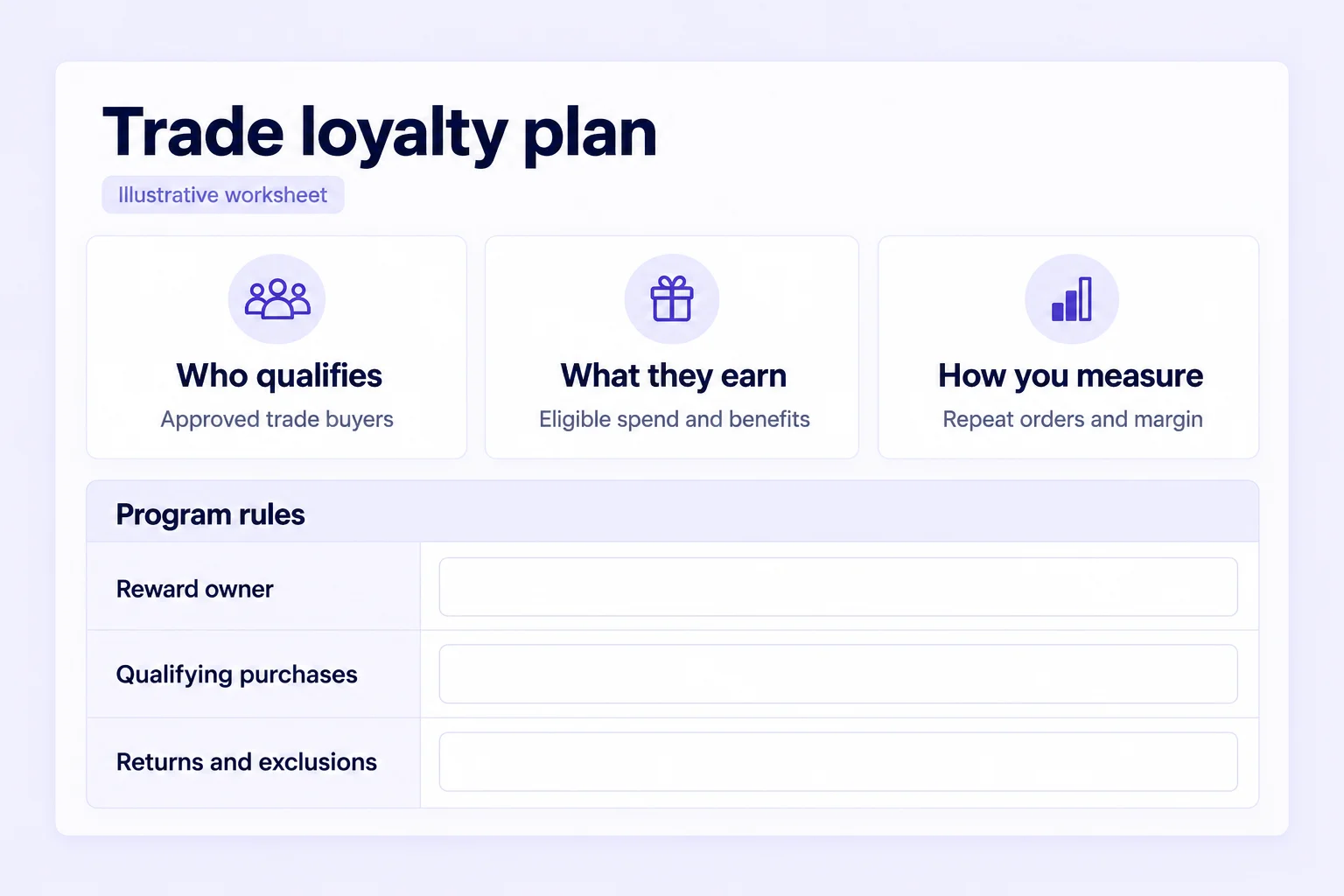
Download the B2B loyalty planning worksheet
Use the free workbook to record program decisions and test evidence. It includes a planning sheet, a worked cost example and a pilot checklist. The CSV contains the planning questions. Both are editable and require no email address.
The worksheet is a manual planning aid. It does not connect to your store, calculate live profitability or certify that an app supports your company-account setup.
Choose the buyer and reward ownership model
Approval answers who can join. Reward ownership answers who earns and spends the value. Write both rules in plain language, including what happens when an employee leaves or a business adds a second buyer.
| Buying relationship | What to define | Implementation question |
|---|---|---|
| Individual trade member | One approved Shopify customer receives their configured membership benefits. | Can this named buyer place and redeem eligible orders in the intended checkout? |
| Company location with several buyers | The location owns purchasing activity or credit; authorized buyers act for it. | Does the system support the location as the reward owner, rather than a personal customer balance? |
| Company with several locations | Specify whether locations qualify separately or share a group target. | Can the proposed implementation aggregate and allocate value correctly? Treat pooling as a requirement to verify. |
Shopify’s native B2B setup uses companies. Its B2B store credit is issued to a company location and shared by authorized buyers there; credit issued to an individual customer is not interchangeable with that location balance. See Shopify B2B and B2B store-credit documentation.
Memberply’s documented trade memberships and store-credit delivery are customer-based. Do not assume that approving a Memberply application creates a native B2B company, supplies catalogs or payment terms, or pools several buyers’ spending. If those are essential, include them in a requirements brief and confirm the proposed approach before purchase.
Five B2B loyalty program examples to adapt
These are fictional program designs, not customer case studies or promised results. Each separates the buyer’s reason to return from the limits that protect the merchant.
| Merchant and audience | Possible benefit | Rule to decide before launch |
|---|---|---|
| Building-supplies store serving contractors | Approved trade pricing, with a higher benefit level after a qualifying spend threshold. | Use customer-level spend unless company aggregation is explicitly supported. Define returns and the qualification period. |
| Homewares store serving interior designers | Access to a professional collection and a member discount on eligible items. | Separate samples, project purchases and excluded collections. Identify who owns the order when an end client pays. |
| Beauty supplier serving salons | Professional product access and a reward on eligible repeat purchases. | Specify eligible products, reward cost and whose account receives the credit. Do not treat consumer and salon buyers as one audience. |
| Food supplier serving independent cafes | A membership benefit designed around a regular replenishment basket. | Cost bulky or chilled delivery separately. Define any minimum order and test mixed baskets. |
| Apparel brand serving stockists | A free approved membership with access benefits, or a paid tier with a clearly costed benefit bundle. | Check existing wholesale margins before adding another discount. Verify compatibility with the actual wholesale pricing setup. |
Choose benefits buyers can use in their work. A designer may value product access; a cafe may care about predictable reorder costs. Adding more rewards does not fix an offer that misses the buyer’s purchasing needs.
Compare trade discounts, spend tiers and store-credit rewards
| Structure | When it may fit | Main tradeoff |
|---|---|---|
| Member pricing | Buyers need a clear, repeatable price advantage. | The cost applies to eligible purchases, including purchases that would have happened anyway. |
| Spend-based benefits | A longer purchasing relationship makes a qualification threshold meaningful. | Choose the period, eligible spend and refund policy; do not confuse lifetime revenue with qualifying spend. |
| Credit on a later order | You want a visible reason to return after an eligible purchase. | Budget the issued value and verify the reward owner and redemption journey. Memberply cashback is store credit, not a cash payout. |
| Access or service-related benefits | Buyers value a professional range, resources or an explicitly scoped service. | Availability and delivery costs still matter. Only promise services your team can fulfil. |
| Paid trade membership | A buyer can see enough recurring value to justify a separate fee. | Explain the fee and terms before application. Do not assume the fee makes every order profitable. |
Start with one primary benefit and a rule buyers can explain to a colleague. Compare spend-based loyalty tiers, member discounts and cashback as store credit.
Cost the reward on an existing wholesale order
An extra benefit can reduce contribution even if revenue looks healthy. Use the price the buyer would actually pay before the new benefit, not a retail list price that the buyer never pays.
In this fictional example, an eligible order is $1,000 excluding tax and shipping. Product cost is $700, and variable fulfilment and payment costs are $50. The baseline contribution is $250. Each option below is separate; the example does not stack a discount and a credit reward.
| Scenario | Calculation | Contribution after the stated costs |
|---|---|---|
| No new reward | $1,000 − $700 − $50 | $250 |
| Additional 5% immediate discount | $950 − $700 − $50 | $200 |
| 5% credit reward, budgeted at full issued face value | $1,000 − $700 − $50 − $50 | $200 planning allowance |
| $20 additional variable service cost | $1,000 − $700 − $50 − $20 | $230 |
The 5% discount costs $50, which is 20% of the original $250 contribution. At the post-discount contribution rate of $200 divided by $950 (about 21.05%), recovering that $50 requires $237.50 in additional net revenue, assuming the same cost rate. That extra demand is a testable hypothesis, not a forecast.
The credit row is a conservative reward budget, not accounting treatment or a model of a later redemption order. Do not subtract the same issued value twice when reconciling actual redemptions. This simplified example excludes membership fees, fixed app costs, tax and changes in cost rates. Use your actual costs and review the loyalty business-case worksheet for a wider program model.
Write the rules buyers and staff need
Identify the eligible buyer
Name the qualifying trade audience and the approved customer or company location. Record how a new buyer, staff departure or changed business relationship is reviewed. Do not use one shared login as a substitute for an ownership design.
Define qualifying purchases
Record the qualifying period, order channels, payment states, product scope, tax and shipping treatment. Keep the spend used to qualify for a level separate from the products on which its discount applies.
Decide what returns change
Specify how partial refunds, cancelled orders and previously issued rewards affect the program. Test the actual implementation before promising automatic reversals or allowing a buyer to keep an earned level.
Explain combinations and limits
Check the interaction with wholesale prices, discounts, credits and other offers. Name any minimums or exclusions and test an order that mixes eligible and ineligible items.
Keep communication relevant
Tell an approved buyer what they can use now. Follow the product’s reorder cycle and stop a reorder reminder when a relevant purchase or unresolved service issue makes it inappropriate. Verify available order data and contact preferences before automating follow-up.
Where Memberply fits in a trade loyalty program
Memberply can support an approved, customer-based trade membership on Shopify. The application controls entry; the membership tier and configured benefits control what an active customer receives. Native company-level workflows need separate compatibility review.
Create a free or paid membership offer
Choose the audience, price and benefit bundle. For a free application tier, approval processing activates access. For a paid application tier, approval authorizes the customer to purchase; benefits begin after successful payment.
Configure the primary benefit
Set up member discounts, exclusive product access or another documented benefit. Match product scope and any thresholds to the offer you have costed. Follow the linked benefit documentation rather than assuming every reward has the same settings.
Set spend qualification deliberately
Spend Tiered Discounts supports current calendar-year or lifetime qualification. Settings control tax and shipping, eligible pre-approval purchases, and whether refunds can reduce an earned level. Membership product purchases and Shopify store-credit payments do not count toward eligible spend. Historical access can limit backfills.
Validate the buyer journey
Test application, approval, any required membership payment, sign-in, an eligible purchase and benefit use. Test another customer and the actual online or in-store route separately. If the store also uses native B2B, verify that checkout path instead of assuming the D2C test proves it works.
Use the application setup guide and spend-tier documentation for the detailed controls. If you need shared company rewards, pooled spend, ERP data or a bespoke workflow, discuss the requirements before committing to an implementation. This guide does not establish those as standard Memberply capabilities.
Run a small pilot before expanding
Start with a defined group of approved buyers and an observation window that fits their reorder cycle. Record the starting purchase pattern, existing negotiated prices and current contribution so a seasonal or project-driven order does not look like a program effect.
| Check | Useful evidence |
|---|---|
| Correct buyer and access | Approved and unapproved customers receive the intended access; a second buyer cannot accidentally spend personal rewards. |
| Correct earning and qualification | A normal order, a mixed basket and a store-credit payment produce the expected eligible spend and benefits. |
| Refund handling | A partial refund and cancellation match the policy, including any change to a spend level. |
| Usable reward | The intended owner can see and use the promised benefit in the actual account and checkout path. |
| Commercial result | Review reorder rate, time to next order, contribution after benefit costs and support effort against a comparable baseline. |
| Communication | Messages use verified data and appropriate permissions; follow-up stops when the buyer’s situation changes. |
Keep purchase behavior and membership status separate. An active paid member may have a long project cycle; an inactive purchaser is not automatically a cancelled member. Review similar buyers and periods before attributing an improvement to rewards. The loyalty KPI guide helps define consistent measures.
The worksheet includes a place to record owners, evidence, limitations and the decision to revise, continue or expand. Use the broader implementation checklist when the program is ready for a full launch.
B2B loyalty program FAQs
What is a B2B loyalty program?
A B2B loyalty program gives eligible business buyers benefits for an ongoing purchasing relationship. It can use member pricing, access, spend-based benefits or rewards. Define who owns the benefit, which purchases qualify and how the program affects contribution before launching.
How is B2B loyalty different from a wholesale discount?
A wholesale discount sets a price for an eligible buyer. A loyalty program adds an ongoing structure, such as earning a higher benefit level through qualifying purchases. An additional reward needs a budget because it can reduce margin on orders the buyer would have placed anyway.
Can Memberply support an approved trade membership?
Yes. A membership application can connect an approved Shopify customer to a free or paid Memberply tier. Benefits can include configured member discounts, exclusive product access and spend-based benefits. Paid membership benefits begin after successful payment.
Does a Memberply trade membership create a Shopify B2B company?
No. Memberply applications create or match a Shopify customer and connect that customer to a membership tier. Shopify B2B company accounts, catalogs and payment terms are separate. Validate the exact checkout and account setup before promising compatibility.
Can several buyers share one reward balance?
Do not assume that individual Memberply memberships pool rewards across buyers. Shopify native B2B store credit belongs to a company location and is shared by its authorized buyers. A program requiring company-level balances or pooled spend needs a separately verified implementation.
Can past purchases count toward a trade member’s spend level?
Memberply Spend Tiered Discounts can count eligible purchases before joining or approval when that option is enabled. The qualification period and access to historical Shopify orders affect what can be included. Shopify store-credit payments are excluded from qualifying spend.
Is the B2B loyalty planning worksheet free?
Yes. Download the XLSX workbook or CSV planning sheet without providing an email address. Use them to record the buyer model, reward rules, costs, owners and test evidence. They do not configure Shopify or verify app compatibility automatically.