
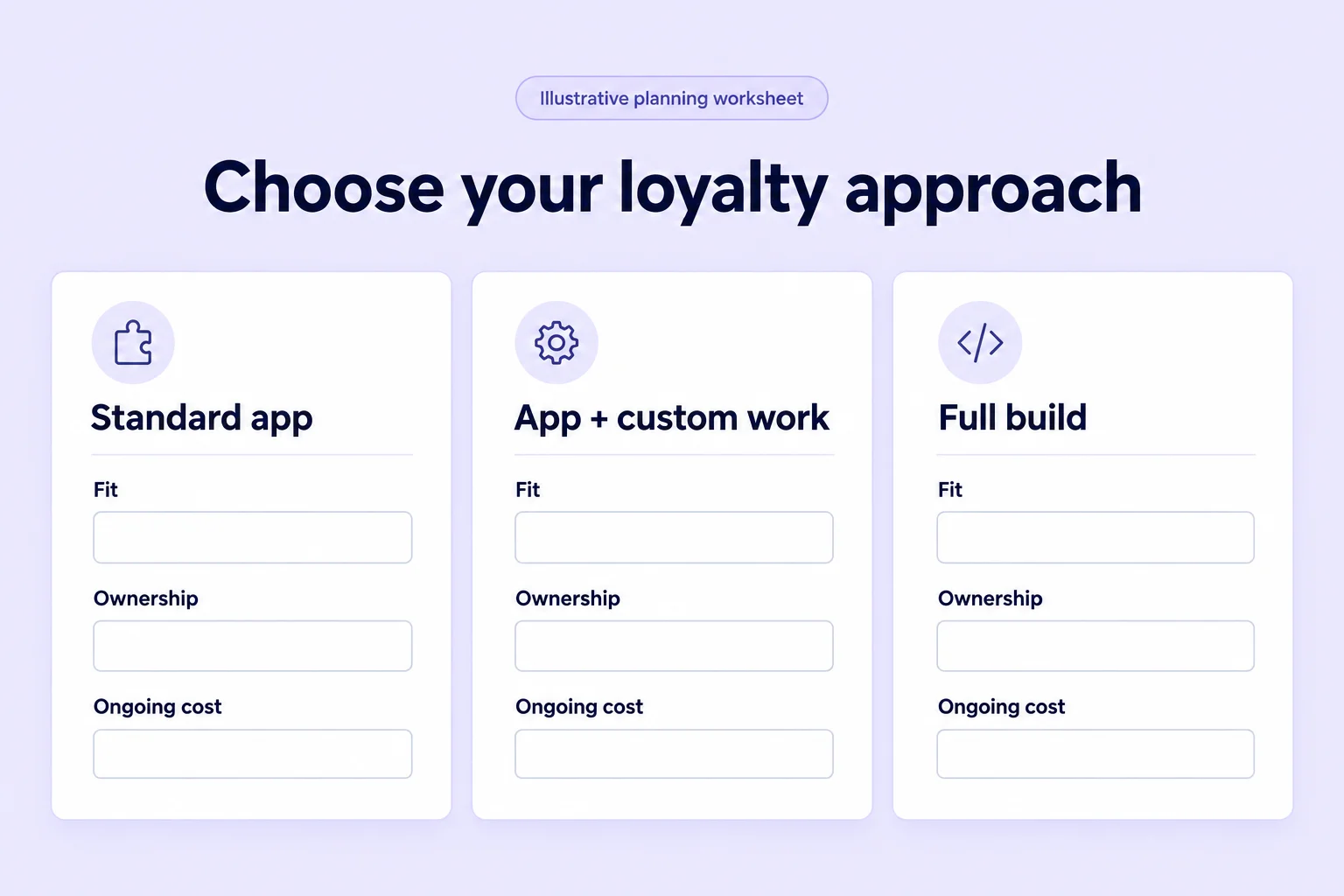
Start with the requirement that changes the decision
Buy a standard loyalty app when it can demonstrate your essential rules and customer journeys. Add custom work when the gap is specific and supportable. Consider a full build when the essential gap remains and you can own the system after launch. None of these choices removes the need to test the program in your store.
Shopify loyalty program development includes more than a points display or branded member page. Someone must own qualification, reward balances, redemption, returns, integrations, support tools and the rules that keep those parts consistent. Decide which of those responsibilities your team needs to control.
This guide compares implementation approaches. Use the loyalty program cost guide for the wider operating budget, and the RFP worksheet when you are ready to evaluate specific proposals.
Compare three development approaches
| Question | Standard app | App + custom work | Full build |
|---|---|---|---|
| What are you implementing? | Configuration of an existing product. | An existing product plus an agreed connection or experience. | A system whose core loyalty logic your project must deliver. |
| What is the strongest reason to choose it? | The essential rules are already supported and demonstrable. | The core fits; a bounded gap needs development. | Essential rules cannot be met by viable existing options. |
| Who maintains the software? | The vendor maintains its product; your team owns configuration and operations. | Vendor, integration owner and merchant share distinct responsibilities. | Your team or contracted operator owns the custom system and its dependencies. |
| What limits flexibility? | Available settings, supported integrations and product roadmap. | The base app and the surfaces it exposes, plus Shopify constraints. | Your budget, engineering capacity, architecture and Shopify constraints. |
| What must be proven? | The actual buying, benefit and support journeys. | The core journeys plus the custom boundary and failure recovery. | The full behavior, operational controls and maintainable delivery plan. |
Treat “custom” as a scope description, not a quality guarantee. A well-supported standard feature can be a better fit than an unfinished bespoke version. A full build can still be justified when the unique rule is central to the business and a durable engineering team can support it.
Download the build-versus-buy decision worksheet
Use the free workbook to record evidence for all three approaches. It includes 14 decision questions, a cost inventory and a handover ownership sheet. The CSV contains the decision questions only. Both are editable and require no email address.
This is a manual planning aid with no scoring or automatic calculations. An unsupported essential requirement should block an option until resolved; do not hide it behind a high average score.
Separate essential rules from preferred presentation
Write the member outcome
Describe who qualifies, what they receive and where they use it. A repeat-purchase reward for replenishment buyers may need different rules from a paid access club. Start with the purchase pattern and benefit, then choose the software.
Identify what cannot change
Record the qualifying period, eligible purchases, reward owner, return treatment and required channels. Explain why each rule is essential. A preferred icon or page arrangement usually has a different decision weight from incorrect reward ownership.
Ask for evidence from the real journey
Use a representative customer, purchase and refund. Test the intended account type and any POS or B2B path separately. A demonstration of a similar feature does not prove the required combination works.
Classify each gap
Label it supported by configuration, feasible through scoped work, unverified or unsupported. Request a small feasibility check for uncertain essentials before committing to a full implementation.
For example, “show active members their benefits” may fit an existing member portal. “Combine a membership benefit with a balance owned by another system” requires a data and ownership review. “Share rewards across companies and stores” is a different system requirement, not simply a new page design.
Three illustrative decisions
| Merchant requirement | Approach to evaluate first | Evidence that could change the choice |
|---|---|---|
| A paid club needs configured discounts, member access and membership-status email segmentation. | Standard app. Prove the exact benefit combinations and customer journey. | An essential rule or account route is unsupported; the standard integration lacks a required field. |
| The membership offer fits an app, but an internal CRM needs an agreed membership event. | App with a scoped integration. Name the source, receiving system and failure owner. | The required event or data is unavailable, or the receiving system cannot safely reconcile missed changes. |
| The program needs a unique shared reward ledger and cross-system settlement rules that shortlisted products cannot demonstrate. | Feasibility work for a full build or a different specialist platform. | The requirement can be simplified, an existing platform proves the capability, or ongoing engineering cannot be funded. |
These are hypothetical decision examples, not customer case studies or promises of Memberply capabilities. A full build should remain an option when justified, but changing the business rule may also be a legitimate choice if its value does not justify the complexity.
Check Shopify constraints before approving a build
A custom application still operates within Shopify’s supported APIs and extension surfaces. Check the required plan, app distribution method, customer-account type and checkout route before accepting a design or development quote.
One material distinction: Shopify says public App Store apps containing Functions can be used across plans, subject to individual API exceptions, while custom apps containing Shopify Function APIs require Shopify Plus. Review the current Function API availability rules for the exact capability. A capability demonstrated in a public app is not proof the same custom-app deployment is available to your store.
Plan ongoing compatibility work. Shopify publishes API versions on a quarterly schedule, with stable versions supported for at least 12 months. Its versioning guidance is a reason to budget review, testing and upgrades beyond launch.
For the merchant experience, use the customer-account customization guide. For systems work, map the actual data and permissions using the loyalty integrations guide.
Ask who owns the difficult days
An integration is not complete when one sample event arrives. The implementation needs a clear answer when a service is unavailable, a customer is duplicated or a return changes the original reward. Ownership matters in all three approaches.
| Responsibility | Question to resolve |
|---|---|
| Records and balances | Which system is authoritative for membership, earned rewards, redemption and reversal? How can support reconcile discrepancies? |
| Repeated or missed events | How do retries avoid double rewards, and how are missed changes found and repaired? |
| Support and permissions | Who can inspect a case, correct it, approve an adjustment and review the audit history? |
| Monitoring and incidents | Who receives alerts, investigates failures and decides whether to pause the affected flow? |
| Changes and upgrades | Who tests platform changes, deploys updates and owns rollback if a release fails? |
| Departure and handover | What happens if the developer, vendor or internal owner changes? Where are the agreed documentation and deployment access? |
Shopify notes that webhooks can arrive more than once and recommends processing that is safe to repeat. Review its webhook delivery guidance. For a merchant evaluating proposals, the useful acceptance test is simple: replay a purchase event and confirm it does not create an extra reward.
An app vendor may handle these controls within its product. Custom work adds responsibility at the connection between systems. Ask for evidence and a named owner rather than assuming either model makes failures impossible.
Compare total ownership cost over the same period
Use the same scope, usage assumptions, service requirements and review period for all options. Keep implementation cash costs, recurring services and internal staff effort visible. A software subscription and a development quote are not directly comparable on their own.
Implementation ownership cost = setup + recurring cost over the chosen period + planned changes + any separately modelled exit work. Include only non-overlapping items. Reward costs and fulfilment belong in the wider program budget; add differences between options when those differences are real.
| Category | What to include |
|---|---|
| Initial work | Discovery, configuration or development, data preparation, migration, acceptance testing and training. |
| Recurring services | App fees, required middleware, hosting, monitoring and support where applicable. |
| Internal capacity | Staff time for program operations and engineering. Distinguish allocated time from new cash spending. |
| Future change | Platform upgrades, security maintenance and planned changes not already covered by a recurring agreement. |
| Exit scenario | Data export, handover and rebuilding any essential dependency if you leave the solution. |
For a fictional example of one option, $6,000 setup + 24 months × $500 recurring support and services + $2,000 planned changes = $20,000 over 24 months. All amounts are assumed US dollars, not a market benchmark or Memberply quote. This example excludes rewards, taxes, additional staff time and exit work; add those where relevant.
Repeat the same calculation with current quotes for each viable option. Check what changes if usage grows or support takes more time. Do not count maintenance twice when it is already included in the recurring quote. The business-case guide helps connect the budget to a measurable pilot.
Where Memberply fits
Memberply’s standard product supports free, one-time paid and recurring membership tiers with configured member benefits. Start by reviewing the existing features and testing the exact offer in your store. Growth includes the standard feature set and unlimited members; member count alone does not create an Enterprise requirement.
The documented Klaviyo and Omnisend integrations sync supported membership properties. Outbound webhooks can send selected membership events to an external endpoint. These capabilities do not establish a generic two-way CRM integration or an unrestricted public loyalty API.
Memberply Enterprise is relevant when a custom integration, member experience, migration or implementation needs separately scoped work. Feasibility, deliverables and ongoing support must be agreed. A full bespoke loyalty engine, shared cross-brand balances or unrestricted account designs are not implied standard services.
If you already have members, assess migration separately. Moving member records is not the same as transferring reward balances or recurring billing. Identify which customer actions and reconciliations are required before promising a seamless cutover.
Make the decision in two stages
Prove the essential gap
Select the smallest demonstration that can confirm or reject the approach. It might be a mixed cart, a refund, a repeated event or an account journey. Define the expected result before testing.
Approve the operating model
Record the chosen approach, evidence, accepted limits, costs and named owners. Agree the handover and change process. If an essential remains unverified, approve only the work needed to resolve it.
Launch a focused pilot
Test with a bounded audience and a clear rollback plan. Watch reward correctness, member support and purchase behavior before expanding. Use the implementation checklist to coordinate the launch.
A decision record should explain why the approach fits today and what would trigger a review. Use the implementation checklist for delivery and the RFP guide for comparing proposals after you have chosen the likely approach.
Turn the model into a practical offer
Use the worked loyalty program designs to check customer value on a realistic basket, then complete the free worksheet and stress tests before configuring the offer.
Loyalty program development FAQs
Should I build or buy a Shopify loyalty program?
Start by testing whether an existing app meets the essential program rules and customer journeys. Consider an app with custom work when the gap is a specific integration or experience. Consider a full build when essential requirements remain unmet and you can fund ongoing engineering and operations.
What does loyalty program development include?
It can include eligibility, earning and redemption rules, member experiences, integrations, migration, administration, testing and ongoing operations. A custom interface alone is not the whole loyalty system.
Is custom loyalty development always more expensive?
No universal cost comparison is reliable without a scope and time horizon. Compare setup, recurring services, internal time, maintenance, planned changes and exit work using current quotes. Keep reward costs visible and avoid counting them twice.
Can a standard app support a custom member experience?
Sometimes. The required data, supported extension points, Shopify account surface and app capabilities determine what is feasible. Validate the specific design before assuming any app can support an unrestricted custom interface.
Does a custom Shopify app remove platform restrictions?
No. Shopify plan, API, extension and distribution rules still apply. Check the exact capability required, especially when using Shopify Functions or designing customer-account and checkout experiences.
When is Memberply Enterprise relevant?
Memberply Growth includes the standard feature set and unlimited members. Enterprise is for separately scoped implementation, custom development and ongoing support. A larger member count alone does not require a custom project.
Does the worksheet choose a winner automatically?
No. The free XLSX workbook and CSV are manual planning aids. Record evidence for essential requirements, costs and ownership before choosing an approach. They do not calculate totals, validate compatibility or replace a project quote.