
8 Shopify customer segmentation examples for repeat purchases
Build useful ecommerce audiences with clear entry rules, exclusions and next actions. Use purchase behavior alongside membership status to make each campaign relevant.
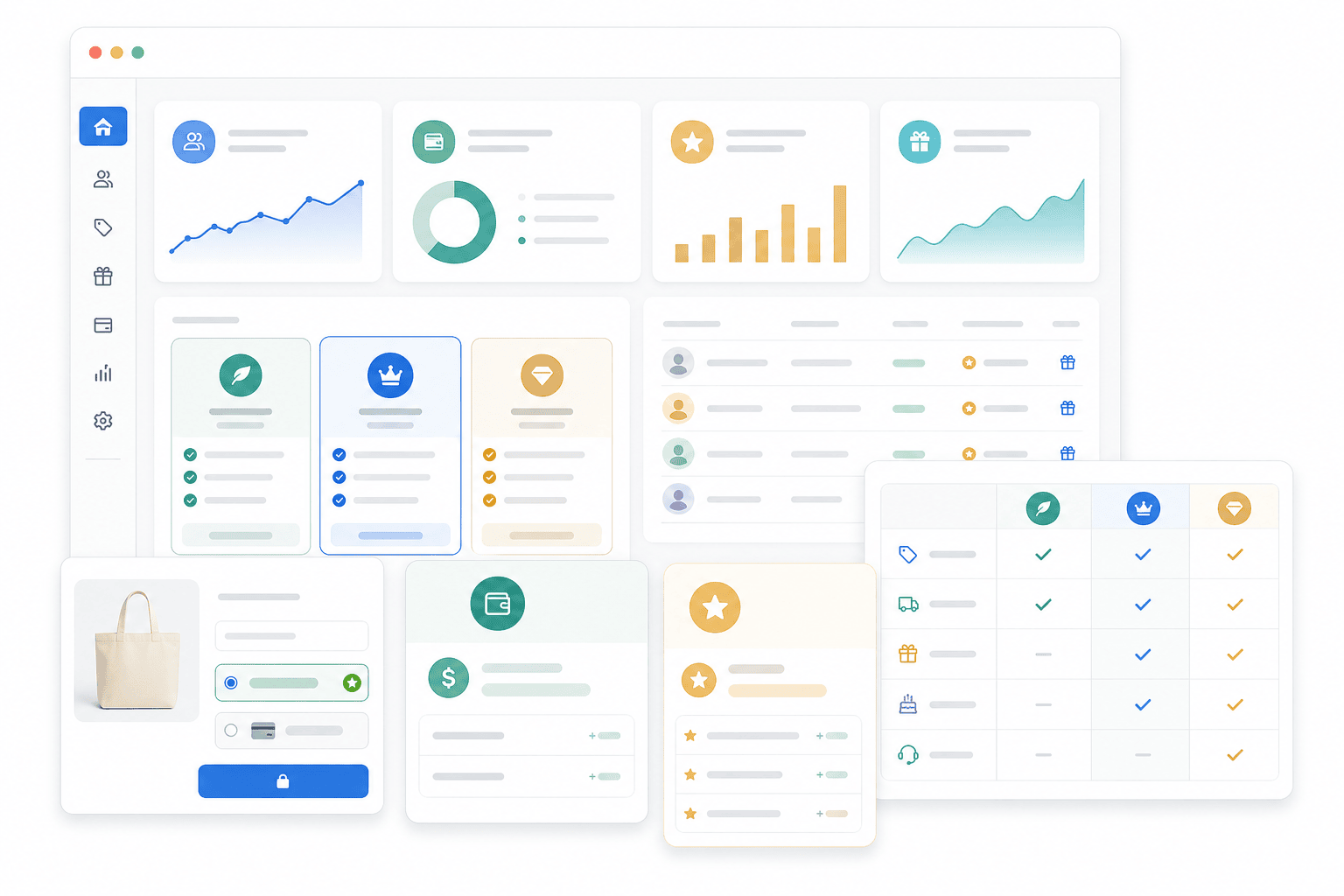
What is ecommerce customer segmentation?
Ecommerce customer segmentation groups customers by shared characteristics that change how you serve them. For a Shopify store, purchase recency, order count, spending and membership status can help determine whether someone needs product guidance, a reorder reminder or a reason to return.
Start with a decision, not a label: what will this customer see differently because they belong to the segment? A useful segment has an entry rule, an exclusion rule, a next action and a measurable outcome.
Explore segmentation methods, audience priorities and RFM, or jump to the eight examples, setup workflow, Memberply data or measurement example.
Choose a customer segmentation method
Choose a segmentation method based on the decision you want to make and the customer data you can verify. These fictional coffee-store examples show how different methods can lead to different actions.
| Method | Example rule | Action and check |
|---|---|---|
| Behavioral | A customer bought a coffee grinder but has not bought beans. | Recommend a suitable bean selection. Exclude customers who already bought it or have an unresolved return. |
| Purchase value | Customers meet your stated spend and order-count thresholds over the same period. | Consider a VIP invitation. Check margin and existing membership before offering paid benefits. |
| Geographic | Customers have a current delivery location within an area you serve. | Explain a relevant delivery or pickup option. Check availability; location alone does not establish product preference. |
| Stated preference | Customers chose whole-bean coffee in a preference form. | Show a matching selection. Use the preference they supplied rather than inferring it from age or other demographic assumptions. |
These methods can overlap. Start with a few useful audiences rather than creating a separate campaign for every combination. Record the source and freshness of each field, and apply marketing eligibility separately.
8 customer segmentation examples for Shopify
These are planning recipes, not prebuilt filters or universal timing benchmarks. Define a qualifying order consistently, including how you handle cancelled, refunded and test orders. Use only customers eligible for the chosen marketing channel.
Scroll the table sideways on smaller screens to see every column.
| Segment | Entry rule | Exclude or check | Next action and measure |
|---|---|---|---|
| 1. First-time buyers | Exactly one qualifying order, delivered recently. | Pause for unresolved delivery issues or returns; remove from the first-purchase offer after another order. | Offer product guidance, then a relevant next purchase. Measure second-order conversion. |
| 2. Recent repeat buyers | At least two qualifying orders and a recent purchase. | Avoid repeating a first-customer introduction; exclude existing members from a join offer. | Recognize repeat custom and explain a suitable membership. Measure joins and repeat orders. |
| 3. Customers due to replenish | Bought a consumable and reached its typical reorder window. | Exclude recent reorders, unsuitable products and active product subscriptions where another order would duplicate delivery. | Link to the relevant refill. Measure reorders over a fixed window. |
| 4. High-value non-members | Meet a defined spend and order-count threshold but have no active membership. | Check refunds, margin and current membership status. A missing integration field is not proof of non-membership. | Explain the benefit at their purchasing frequency. Measure paid joins and contribution after benefits. |
| 5. Active members in a tier | Current active membership and the selected tier. | Exclude benefits unavailable to that tier; check current eligibility before sending. | Link to usable perks in Shopify new customer accounts. Measure benefit use and subsequent orders. |
| 6. Customers with available credit | A verified, current credit balance above your chosen threshold. | Recheck the balance and any expiry before sending; exclude spent or unavailable credit. | Show where to use existing value. Measure redemption and order contribution. |
| 7. Lapsed purchasers | Previous buyer whose last purchase is beyond the category’s normal repeat interval. | Exclude recent buyers and unresolved service problems. Inactivity alone does not mean a membership has ended. | Offer a relevant return reason. Measure repeat purchases against a comparison group. |
| 8. Former members | Confirmed inactive membership, with the previous tier recorded. | Exclude active members and people whose cancellation is only scheduled for later. | Explain a relevant reason to reconsider. Measure reactivation separately from ordinary purchases. |
For the message strategy behind these audiences, see post-purchase examples, VIP lifecycle campaigns and member win-back planning.
Choose thresholds from your own purchase cycle
A fictional coffee shop might test a replenishment audience 25 to 40 days after a bag purchase, while a furniture store needs a very different interval. These numbers illustrate a hypothesis, not a recommended benchmark. Compare the time between repeat orders for the same category before setting a delay.
Define a VIP group using a stated period and threshold. A shopper who spent 500 in your store currency over a year is different from one who spent that amount over their lifetime. Check profit and refunds alongside revenue, and keep existing paid members separate from prospective members.
Recency, frequency and monetary value are useful dimensions, but no fixed percentage of customers can be assumed to generate a fixed share of profit. Use your store’s distribution. For planning, the customer lifetime value calculator can help compare assumptions; it does not identify individual customers automatically.
Plan a relevant product recommendation
Use the cross-sell email examples to choose complementary products, write a focused message and exclude customers who already bought the recommendation.
What to send when customer segments overlap
Illustrative example: Alex is an active paid member, meets the store’s VIP purchase threshold and is due to reorder coffee. Those three labels describe one person, not three reasons to send a promotion today.
For contacts who browse without progressing to cart or checkout, use the browse abandonment guide to match the message to verified event data.
- Check whether a promotion is appropriate. Confirm marketing eligibility and pause promotional messages if a delivery problem or return needs attention. Keep necessary service messages separate.
- Choose the most relevant next action. If Alex has not reordered and the timing fits their purchase history, a refill reminder may be useful. Mention an existing membership benefit only after checking that it applies to the order.
- Suppress competing offers. Exclude Alex from the non-member join campaign. Defer an unrelated VIP promotion according to your contact-frequency rules rather than sending both automatically.
- Check again before sending. A new order should stop the stale refill reminder. A membership change should trigger a fresh benefit-eligibility check.
Write the priority rule in your marketing platform and test a sample customer who belongs to several audiences. This is a campaign-planning example, not an automatic priority system supplied by Memberply. Use the customer lifecycle guide for journey planning and the VIP email guide for message ideas.
How to build and check a customer segment
Shopify provides filters for order count, spending, last order date, email subscription status and other customer data. Check the official Shopify filter reference for supported fields and definitions. A rule in this guide may require combining data in your marketing platform rather than one Shopify filter.
- Write the audience rule in plain language. State the behavior, time window and exclusions before choosing fields. Record the source for each condition.
- Check real sample records. Inspect customers near the threshold, a recent purchaser, an active member and someone with missing data. Confirm each belongs inside or outside the audience for the intended reason.
- Choose one next action. A refill collection, membership page and account benefit screen serve different purposes. Match the destination to the segment.
- Recheck eligibility before each send. A customer may purchase, join or use credit after entering a sequence. Configure the campaign’s stop rules and contact frequency.
- Launch a controlled test. Record the audience definition, offer cost, measurement window and success metric so results can be compared fairly.
In Klaviyo, trigger conditions and profile filters serve different roles; profile filters can be checked again as a flow progresses. Use its trigger and filter documentation to implement exclusions in the appropriate place.
Use RFM alongside membership status
RFM means recency, frequency and monetary value: how recently a customer purchased, how often they ordered and how much they spent. It helps you distinguish recent repeat buyers from customers whose strong purchase history has become less active.
Shopify’s RFM customer analysis report assigns customers to groups using purchase data relative to your store. Individual numeric scores are not displayed in the admin. You can preview a segment from a report group or use the rfm_group filter in customer segmentation.
For example, review a previously frequent buyer whose orders have slowed, then check product replenishment needs and service history before choosing a return message. Compare customers with similar buying cycles; a furniture purchase and a coffee order need different interpretations.
RFM describes purchase history. It does not establish profit, active membership, marketing consent or the reason someone stopped buying. Add those checks separately, and do not treat a high spending score as permission to send more messages.
For a complete scoring walkthrough and practical next actions, read our RFM analysis guide.
Use verified Memberply membership data in Klaviyo
Memberply’s Klaviyo integration syncs membership status, current and previous tier information, and cancellation dates as profile properties. It does not change email marketing consent. Build your marketing eligibility rule separately from membership eligibility.
- Active members: use
memberply_member_statusequal toactive. - One active tier: combine active status with
memberply_membership_tier_nameor the tier product ID. Use the ID if names may change. - Former members: combine inactive status with
memberply_last_membership_tier_name. Current tier fields are cleared when membership becomes inactive. - Scheduled cancellation: inspect
memberply_membership_cancellation_scheduled_atwhile the membership may still be active. Do not treat a future cancellation as expired access.
The documented integration does not list credit balances, points balances or benefit-redemption history among these profile properties. A credit-based segment needs a separate verified source for that data. Do not infer it from membership status.
Follow the Klaviyo integration documentation and check a synced profile before using a property. Connect the campaign to the member experience in Shopify new customer accounts so promised benefits are available after the click.
Measure incremental repeat purchases, not just opens
Choose a fixed outcome window before sending. For a second-purchase campaign, count customers who place another qualifying order within that window, divided by the eligible customers assigned to the campaign. Use the same definition for a randomly selected holdout that does not receive the campaign.
For first-purchase groups followed over equivalent periods, see our Shopify customer cohort analysis example.
Use post-purchase surveys to investigate customer needs alongside purchase behavior, without treating stated intentions as actual orders.
Illustrative example: 40 of 500 customers assigned to the campaign buy again within 30 days, versus 30 of 500 in the holdout. That is 8% versus 6%, a difference of 2 percentage points. Applied to the 500-person campaign group, that corresponds to 10 additional purchasing customers. It is not a guaranteed result or proof from one small test.
Then account for discounts, redeemed credit, product costs and fulfillment. At 12 in contribution per incremental purchasing customer before campaign-specific costs, 10 extra purchasing customers contribute 120; subtract 150 in campaign costs and the example is negative 30. Evaluate margin alongside repeat purchases and membership joins.
Keep purchase retention and membership retention separate. A customer can buy again after ending a membership, or remain a member without a recent product order. See customer retention examples for related experiments.
Use the ecommerce KPI worksheet to keep second purchases, starting-member retention and contribution per order separate. Its second-purchase calculation uses a full 90-day follow-up after the first order. The campaign example above uses a 30-day campaign window; do not compare the two rates as if their audiences and observation periods were identical.
Shopify customer segmentation questions
What are useful Shopify customer segmentation examples?
Start with first-time buyers, repeat buyers, replenishment customers, high-value non-members, active members, customers with available credit, lapsed purchasers and former members. Each group needs a defined rule, exclusions and a measurable next action.
How do I choose a win-back delay?
Use the normal repeat-purchase interval for the relevant product category. Test a delay against your own order history rather than treating the same number of days as suitable for every store.
Are VIP customers and paid members the same segment?
No. VIP can describe purchasing value, while paid membership describes access to a program. A high-spending customer may not be a member, and a new paid member may have little order history.
Can I segment by unused store credit?
Yes, if your chosen platform has a reliable current credit balance for the customer. Verify the source, eligibility and expiry. Memberply’s documented Klaviyo profile sync does not itself list credit balance as a synced property.
Does Memberply subscribe members to marketing emails?
No. Its Klaviyo integration updates membership profile properties without changing marketing consent. Apply your channel eligibility rules separately.
How do I know whether a segmented campaign worked?
Compare qualifying purchases, joins or reactivations over a fixed period, ideally against a randomized holdout. Account for offer and fulfillment costs. Email-attributed revenue alone does not show how many purchases the campaign caused.
What should I do when a customer belongs to several segments?
Choose one relevant next action, apply marketing eligibility and service exclusions, and suppress competing promotions. Recheck purchases and membership status before sending so the customer does not receive an outdated offer.
Is RFM segmentation the same as membership segmentation?
No. RFM groups customers by purchase recency, frequency and spending. Membership segmentation uses current program status and tier eligibility. Combine verified information from both when choosing an offer, and check marketing consent separately.
Merchant reviews
Merchants use Memberply to launch practical membership programs
Read what merchants say about using Memberply for their membership programs. Read reviews on the Shopify App Store.
"The app is great and does exactly what i need it to. It is well priced and Doug is so great."
Olverum Official Store
United Kingdom
"Their pricing is fair, and their support is legendary."
Puzzery
Canada
"Our store is based in Argentina so we don't have access to Shopify Payments... Memberply solved it."
Elemental Outfit AR
Argentina
Ready to segment customers around membership value?
Use Memberply to connect customer segments with paid tiers, benefits, Klaviyo and customer account value.