Café loyalty
Coffee shop punch card math: buy 5 or buy 9?
A free sixth coffee gives a regular a 16.7% discount across six drinks. A free tenth gives 10%. To choose between them, count how many extra paid coffees each card needs to cover the drinks you give away.
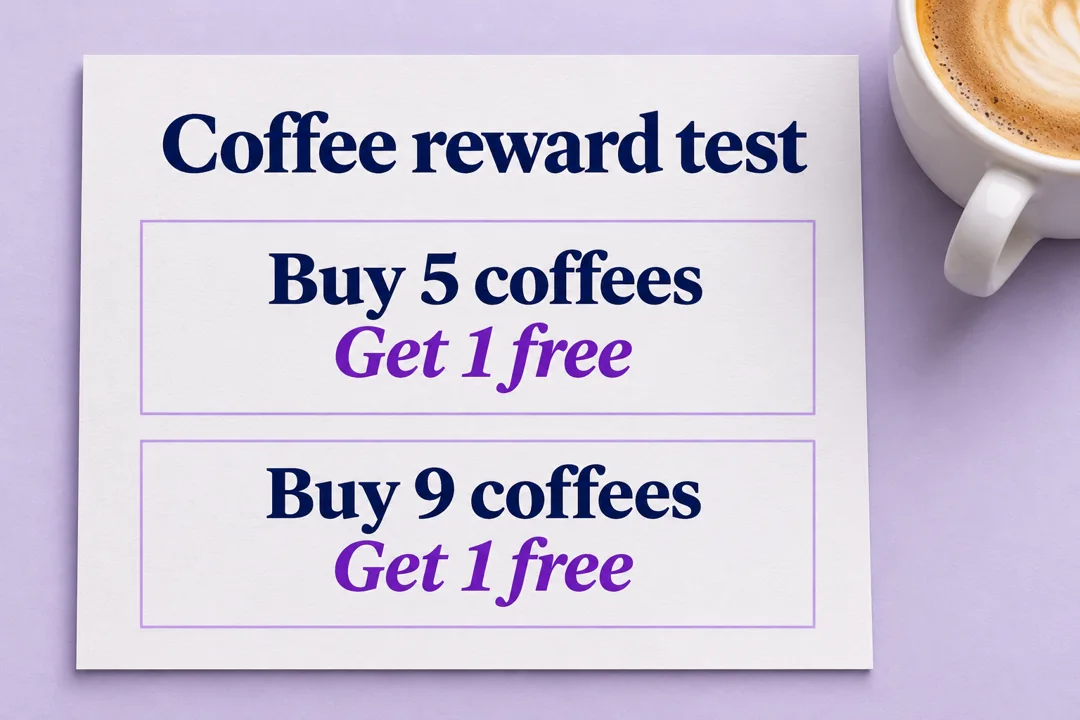
How much does a completed coffee card give away?
Suppose a regular latte sells for $4.80. Each qualifying paid drink earns one stamp. The reward is a regular latte, and its redemption earns no stamp. A customer who buys two eligible drinks gets two stamps, even on one receipt. State that rule before printing cards.
| Offer | Drinks received | Customer pays | Average paid per drink |
|---|---|---|---|
| Buy 5, get 1 | 6 | $24.00 | $4.00 |
| Buy 9, get 1 | 10 | $43.20 | $4.32 |
This calculation describes a completed card. Someone who buys two coffees and never redeems pays $4.80 for each. Someone who buys one qualifying coffee a week reaches five stamps in five weeks and nine stamps in nine weeks. Give both groups enough time to earn and use the reward before comparing them.
Count the paid coffees that cover the free ones
Suppose beans, milk, cup and other variable costs total $1.20 per drink. Each paid $4.80 drink contributes $3.60. Giving away 36 coffees costs $43.20 to make. Add $20 for the card run and incremental staff time. The café must sell at least 18 extra paid drinks to cover $63.20, since $63.20 ÷ $3.60 is 17.56.
Use your own menu mix. If customers can redeem for large drinks or add extra shots, cost the actual reward mix. Include payment fees in paid-drink contribution and any extra labor the promotion requires. Separate tax collected for the government from sales in the worksheet.
A three-group café test
These invented figures show how to make the decision. Randomly offer 100 comparable shoppers each card, and keep 100 on ordinary pricing. Use the same dates and stores. Suppose the ordinary-pricing group buys 285 paid drinks during the test. Count paid drinks and free drinks separately.
| Metric | Buy 5 | Buy 9 |
|---|---|---|
| Paid drinks | 300 | 298 |
| Extra paid drinks versus 285 | 15 | 13 |
| Free drinks redeemed | 36 | 14 |
| Extra paid contribution at $3.60 | $54.00 | $46.80 |
| Free drink cost at $1.20 | $43.20 | $16.80 |
| Extra operating cost | $20.00 | $20.00 |
| Change in contribution | −$9.20 | +$10.00 |
The shorter card produces two more paid drinks than the longer card but costs $26.40 more in free drinks. In this example, the nine-stamp offer clears its costs and the five-stamp offer falls short. With only $10 of headroom, another nine free drinks at $1.20 each would wipe out the gain. Count open cards and revisit the result after a full redemption cycle.
The paid-drink difference already includes customers who took a free drink when they would have bought one. Subtracting another full menu price for every free coffee would count those lost sales twice. If a discount shifts demand into a queue you cannot serve, record lost sales and staffing effects separately.
What the barista needs on the counter
Print one sentence customers can repeat: “Buy nine regular hot drinks and your next regular hot drink is free.” Decide whether alt milk, syrups, iced drinks and multiple cafés qualify. Record a free drink on the till so redemptions have a count. Try two drinks in one order, a refunded drink and a reward with an upgrade before launch.
Keep the program consistent during the test. Record customers offered the card, returning customers, paid drinks, redemptions and outstanding stamps for each group. Comparing only completed cards selects for your most frequent customers. Divide results by everyone assigned to each offer, including people who never came back.
For paper versus digital handling, compare coffee loyalty apps for Shopify POS. If regulars want ongoing bean discounts or shipping perks, compare café rewards with a coffee membership. A paid membership and a visit-count punch card require different checkout tests.
Coffee punch card questions
What discount is buy five coffees, get one free?
For six equal-priced drinks, the customer pays for five. The discount on the six-drink total is 1 ÷ 6, or about 16.7%, when they redeem the reward. Buying nine and receiving the tenth free gives a 10% discount.
Should I use a drink’s menu price or its cost for a reward?
Use the variable cost of making the reward drink when you compare observed paid sales with a comparable group. If a reward replaces a paid sale, that loss already shows up in the paid-sales difference.
Should online bean purchases earn café stamps?
Only if the terms promise it and both channels can record and redeem the entitlement correctly. Test the two receipts and balances before combining them. A drink-based card can stay in-store while a separate membership covers beans.
Trusted by Shopify merchants







Measure the return visit
Mark the first visit for each shopper, choose a follow-up window and compare the share that comes back. Use the repeat purchase rate calculator alongside paid-drink contribution. A higher return rate can still cost more than it earns.
Evaluating a paid coffee club with member benefits? Explore Memberply on the Shopify App Store.