
Free Shopify tool
Repeat purchase rate calculator for Shopify
What share of your buyers placed at least two orders during the period you are measuring? Enter unique customer counts from the same dates to find out.
Trusted by Shopify merchants








Calculate your repeat purchase rate
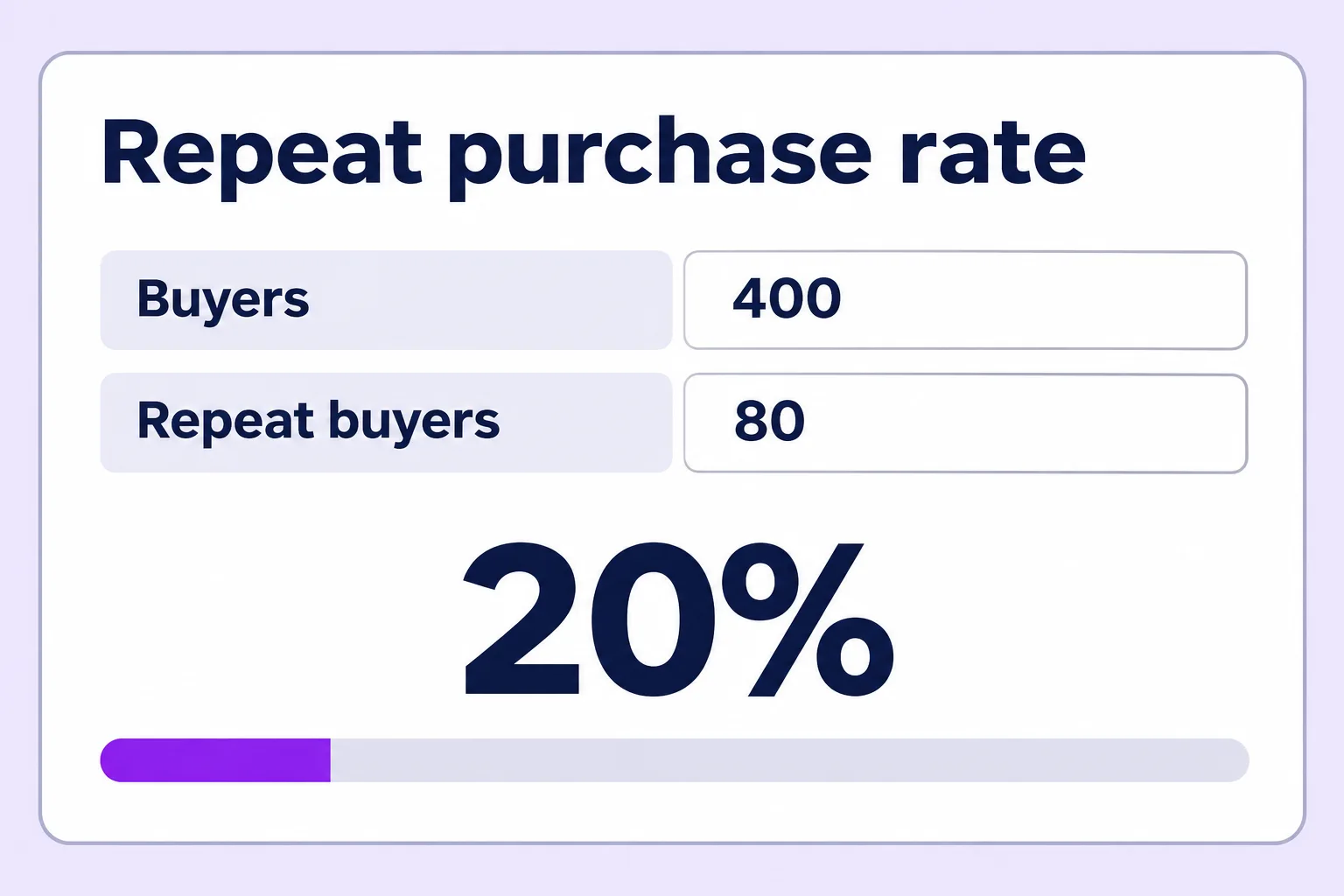
Repeat purchase rate
Repeat purchase rate = unique repeat buyers ÷ all unique buyers × 100. For example, if 80 of 400 buyers placed at least two orders in April, the rate is 80 ÷ 400 × 100 = 20%. The other 320 buyers each placed one qualifying order. Someone who placed five orders counts as one repeat buyer.
Get the two numbers from your orders
Choose a start date, end date and store time zone. Use one record per paid order and group those orders by a consistent customer identifier across sales channels. If your export has a row per line item, count each order ID only once. Review unmatched guest purchases before comparing months.
Exclude test orders, cancellations and fully refunded orders. For this example, a partially refunded order counts if it retains a positive paid value. Use the same rule and refund cutoff each period. Count all buyers with at least one qualifying order, then count how many of those buyers have two or more.
When to use a first-order cohort instead
Suppose a shopper first orders on 28 April and returns on 6 May. April records one buyer and zero repeat buyers for this shopper. A 60-day April first-buyer cohort records a successful repurchase. Use the period rate to describe activity inside a month. Use a cohort when you want to know whether new customers return within a set time, and give each customer the full observation window.
Compare periods of equal length and similar seasonality. A promotion that brings in many new buyers can lower the period rate even when the usual customers still reorder. For a worked cohort example, see the customer loyalty ladder.
Repeat purchase rate questions
How do you calculate repeat purchase rate?
Divide unique customers with at least two qualifying orders in the period by all unique customers who ordered in that period, then multiply by 100.
What happens when there are no buyers?
The rate is undefined because the denominator is zero. With at least one buyer and no repeat buyers, the rate is 0%.
Why might my Shopify returning customer figure differ?
A buyer who ordered last month and once this month can be returning based on their purchase history. This calculator counts them as a repeat buyer only when they have at least two qualifying orders within your selected period.
Merchant reviews
Merchants use Memberply to launch practical membership programs
Read what merchants say about using Memberply for their membership programs. Read reviews on the Shopify App Store.
"The app is great and does exactly what i need it to. It is well priced and Doug is so great."
Olverum Official Store
United Kingdom
"Their pricing is fair, and their support is legendary."
Puzzery
Canada
"Our store is based in Argentina so we don't have access to Shopify Payments... Memberply solved it."
Elemental Outfit AR
Argentina
Put repeat purchases in context
Review the other loyalty program KPIs alongside repeat purchase rate before changing your rewards.