
Membership marketing strategy for Shopify stores
Promote your paid membership across the moments where shoppers decide to buy, join, renew and keep using their benefits.
Quick answer
A good membership marketing strategy repeats the value
Membership marketing is not just one announcement. Customers need to see the offer before joining, understand the value while buying, and receive reminders after they become members.
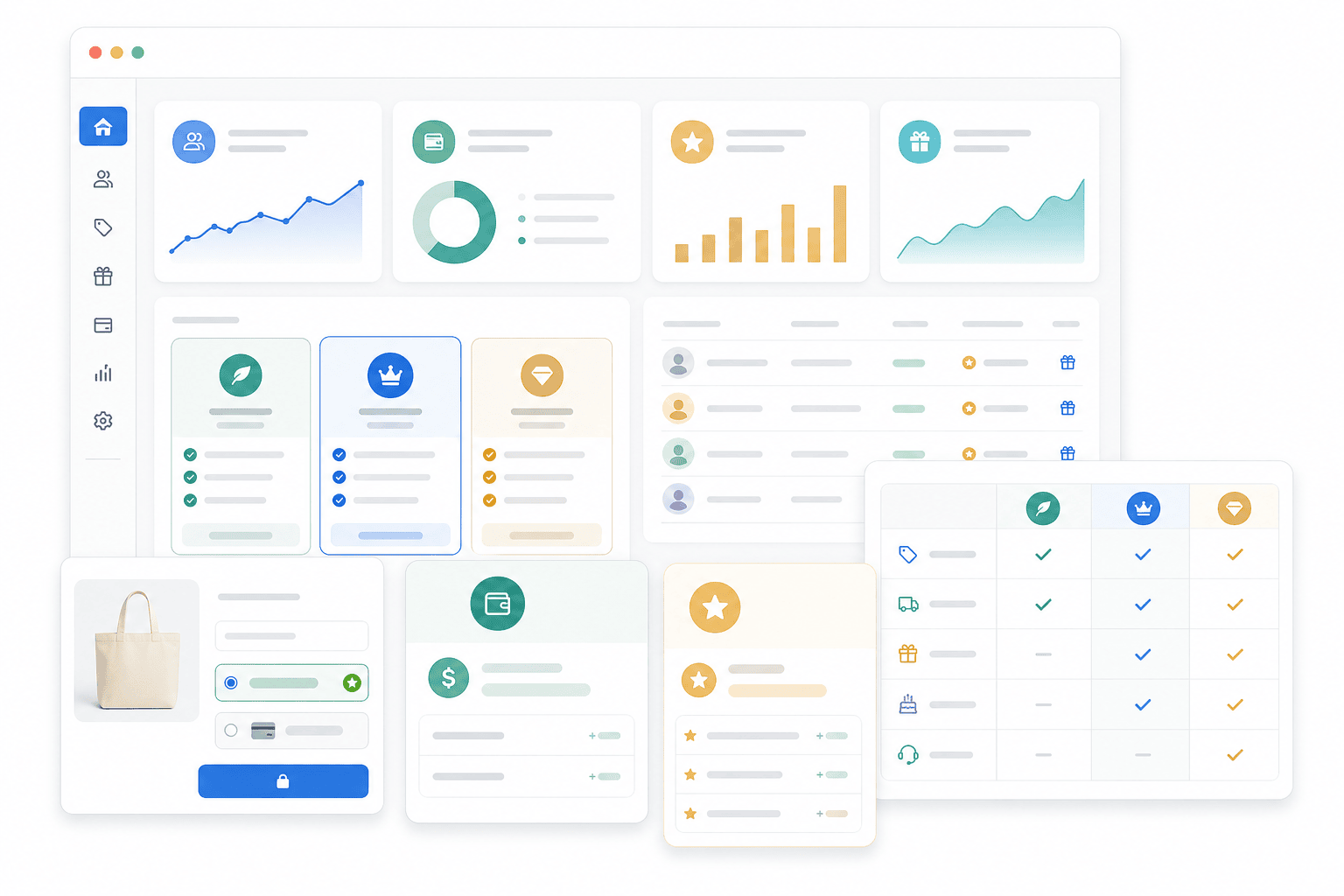
For Shopify merchants, Memberply supports a practical membership marketing path with landing pages, product page upsells, cart page upsells, floating widgets, member emails, customer accounts, Shopify POS and Klaviyo. Use a post-purchase membership offer when the benefit fits a recent buyer’s future needs, and plan seasonal pushes such as a Black Friday membership promotion. After a customer joins, use a clear membership onboarding strategy.
Best fit for Memberply
Use Memberply when your paid membership needs a clear launch path, storefront promotion, ongoing member reminders and benefit visibility after signup.
Membership marketing channels to cover
A good strategy uses each surface for the job it does best.
1. Membership landing page
Explain the full offer, tiers, pricing, benefits, FAQs and reason to join.
2. Product page upsells
Show the membership when shoppers are already comparing product value.
3. Cart page upsells
Promote the benefit when shoppers can see the value against the current order.
4. Floating widget
Keep the membership visible as customers move through the storefront.
5. Member emails
Use welcome, renewal and event messages to reinforce ongoing value.
6. Klaviyo and POS
Use member data for segments and in-store conversations when the context matters.
Membership marketing plan template: complete these fields
Use this short worksheet before choosing channels. Copy the fields into your planning document and give each action an owner. A membership marketing plan connects a suitable shopper, a useful offer and a working joining path.
Shopper and problem
Who is this for, what do they already buy and what recurring problem does membership solve? Use realistic purchase habits, not an assumption that every customer needs another subscription.
Core benefit and terms
Write one reason to join. Record the fee, currency, billing period, renewal terms, benefit eligibility and exclusions. Link the full terms instead of hiding important limits behind a vague VIP label.
Audience and exclusions
Define who will see each invitation. Exclude existing members from join-again messages, honor marketing preferences and avoid promoting an unsuitable paid offer to occasional shoppers.
Placement and destination
Choose where the offer appears and where the shopper goes next. Record the exact landing page or joining path and verify the intended tier and purchase option.
Owner and timing
Name who prepares the page, checks the benefit, publishes each placement and handles support. Choose a review window appropriate to the buying cycle, not an arbitrary deadline to force signups.
Evidence and decision
Record the baseline, audience size, completed joins, first benefit use and costs where measurable. Decide what problem should pause promotion and what evidence would justify a wider rollout.
Use the benefit-selection guide and membership pricing guide to test the offer. Put the reviewed terms on a clear joining page.
Filled example: a retail essentials membership pilot
This fictional planning example is not a real merchant campaign, a Memberply default or a promised result. The $10 monthly fee is the shopper’s membership fee, not Memberply app pricing.
Shopper and offer
A household-essentials store tests a $10 monthly membership with 10% off eligible products. It considers regular buyers who already purchase those products; gift cards and sale products are excluded in this example.
Value check
A shopper buying $100 of eligible products in a month receives $10 in discounts before paying the $10 fee. That is break-even, not a saving. At $150, the discount is $15 and the net saving is $5, assuming no overlapping public offer. Merchant margin must be checked separately.
Audience and placement
The marketing owner prepares a limited invitation for suitable existing customers who can receive marketing. Existing members and shoppers who cannot use the benefit are excluded. The invitation points to the reviewed membership page; it does not change the customer’s membership automatically.
Ownership and readiness
The store owner approves pricing and costs. The ecommerce owner tests the tier, checkout and eligible/excluded products. The support owner reviews the help route and common questions. Promotion starts only when the relevant launch checks pass.
Timing and review
Run the initial review over a period that gives the intended shoppers a realistic chance to buy. Check broken links and confusing terms promptly; wait for a suitable purchase window before interpreting quiet members as poor fit.
Wider rollout decision
If the joining and benefit paths work and the offer remains useful and affordable, test another placement. If people misunderstand the fee or exclusions, correct the page first. Do not set a first-100-members target as a substitute for checking fit.
Choose promotion channels by audience and purpose
Acquiring a member and helping an existing member are different jobs. Keep the offer consistent, but use the right destination and sending process for each audience.
Storefront page and navigation
Audience: interested visitors. Owner: ecommerce team. Explain the full offer on a landing page, make it discoverable in navigation and test the joining button. Measure relevant visits and completed memberships separately.
Product and cart placements
Audience: shoppers considering eligible purchases. Owner: ecommerce team. Memberply supports product-page and cart membership upsells. These appear before a purchase; they are not a claim of a native post-purchase checkout extension. Verify the fee and all benefit conditions in the resulting cart or checkout.
Customer marketing invitation
Audience: suitable nonmembers who can receive your marketing. Owner: marketing team. Use your chosen marketing platform and its audience controls. Memberply’s welcome and renewal emails are not a general prospect-campaign sender.
In-store explanation
Audience: shoppers for whom the offer may be relevant. Owner: store team. Explain the fee and benefit without pressure and direct them to the verified joining path. Test any POS benefit separately; an online check does not establish that an in-store flow works.
Welcome and account access
Audience: people who have joined. Owner: member-experience team. Confirm their tier, explain the first useful benefit and link to their account. Use the welcome-pack checklist rather than asking them to join again.
Member follow-up
Audience: members whose status and needs match the message. Owner: retention team. Memberply can sync membership status and tier properties to Klaviyo; it does not change marketing consent. Use reliable data and avoid repeated messages after the relevant action is complete.
Follow the current Klaviyo integration documentation for available properties. For message structure, use the membership email examples. Do not infer purchase eligibility, consent or unused benefits from a tier name alone.
Move from preparation to pilot to broader rollout
- Preparation: finalize one offer, its costs, audience and joining page. Assign owners and run the implementation test matrix and go/no-go checklist. Unclear billing terms or a broken benefit path should block promotion.
- Limited pilot: introduce the offer to a defined suitable audience. Record the invitation or exposure window, questions, completed joins and benefit experience. Fix operational issues immediately. A small pilot provides learning, not statistically reliable proof of demand.
- Broader rollout: expand only after the offer and customer journey are ready. Add one placement at a time where practical, retaining the same terms so you can understand what changed. Monitor support workload and benefit costs as well as signups.
There is no universal launch-week result to aim for. A monthly replenishment store and a seasonal retailer need different observation windows. Use short membership questions to investigate confusion, alongside actual outcomes.
Measure the membership launch with clear denominators
A click is not a paid membership, and a membership purchase is not proof that the shopper used or valued a benefit. Define each step before comparing channels.
Fictional funnel, not a benchmark
Assume a store can reliably link these unique people within one defined pilot cohort and time window. It invites 200 eligible nonmembers, 80 visit the joining page, 24 click the joining action, 12 complete a membership purchase and 9 of those new members use an eligible benefit within the stated follow-up window.
- Page visits per invited person: 80 ÷ 200 = 40%.
- Joining clicks per page visitor: 24 ÷ 80 = 30%.
- Completed memberships per joining click: 12 ÷ 24 = 50%.
- Completed memberships per invited person: 12 ÷ 200 = 6%.
- First benefit use per new member: 9 ÷ 12 = 75% within the chosen follow-up window.
These figures illustrate the arithmetic only. An invitation is not proof of delivery or attention. Report unique people or sessions consistently; do not mix them. If your tools cannot link the steps reliably, report them separately rather than claiming a connected funnel. Include the dates, channel and cohort definition with every rate.
Separate free signups from completed paid memberships, review refunds and cancellations, and track renewal only when a renewal opportunity has occurred. Compare membership revenue with benefit, fulfilment, support and acquisition costs. A before-and-after lift can reflect seasonality or a different audience; it does not prove the promotion caused the result. App Store installs measure Memberply acquisition, not your store’s membership launch.
First review: fix confusion before increasing promotion
- Broken joining path: can shoppers choose the intended tier and complete the correct purchase?
- Misunderstood price: can they explain the amount due, billing interval and renewal terms?
- Unsupported promise: does each advertised benefit exist and work for the intended customer?
- Unexpected exclusion: are product, shipping and discount-combination limits visible before joining?
- Weak offer fit: do normal purchases justify the fee without encouraging unnecessary spending?
- Unusable reporting: can the team distinguish visits, joins and benefit use without guessing?
A larger audience will not fix a confusing offer. Revise the plan, retest the affected journey and document the change before restarting the next promotion.
What to include in the strategy
Keep the plan simple enough to launch, but complete enough that customers repeatedly see the value.
The core promise
Define the one reason customers should care before listing every benefit.
The conversion path
Map where the membership appears across landing pages, product pages, cart pages and navigation.
The retention path
Plan how members see store credit, discounts, points, free shipping and access after joining.
The message calendar
Use email, Klaviyo, events and customer-account reminders to keep the membership active.

Program design
How to sequence the membership launch
Before launch: make the offer specific
Decide whether the hook is store credit, discounts, free shipping, VIP access, reward points, events or a combination of benefits.
Pilot: test a relevant placement
Use the landing page for the full pitch, then reinforce the offer on product pages, cart pages and email.
After launch: help members use benefits
Use customer accounts, member emails, Klaviyo segments and POS conversations to remind members what they can use.
Membership marketing questions
Clear answers for Shopify merchants planning how to launch, promote and grow a paid membership.
What should a membership marketing plan template contain?
Include the intended shopper, problem, core benefit, fee and terms, audience exclusions, placement and destination, owner, timing, measurement and rollout decision.
How should I measure a membership launch?
Measure relevant visits, joining clicks, completed memberships and first benefit use separately, with explicit audiences and time windows. Review benefit costs and later renewals rather than treating clicks as proof of customer value.
What is membership marketing?
Membership marketing is the process of explaining, promoting and reinforcing a membership program so customers understand why to join, what they receive and how to keep using their benefits.
How do I promote a membership program on Shopify?
Promote a membership program on Shopify with a dedicated landing page, product page upsells, cart page upsells, floating widgets, navigation links, customer accounts, email, Klaviyo segments, Shopify POS and post-purchase flows.
What should a membership marketing strategy include?
A membership marketing strategy should include the offer, benefits, launch message, storefront placements, email plan, retention reminders, customer-account visibility and measurement for completed memberships, benefit use, renewals and repeat purchases.
Can Memberply help market paid memberships?
Yes. Memberply helps Shopify merchants market paid memberships with landing pages, product page upsells, cart page upsells, floating widgets, member emails, customer accounts, Shopify POS support and Klaviyo member data.
Trusted by Shopify merchants








Ready to market a paid membership?
Use Memberply to promote the offer, explain benefits and keep membership value visible after customers join.
Merchant reviews
Merchants use Memberply to launch practical membership programs
These reviews describe Memberply generally, not the planning examples above. Read what merchants say about their membership programs. Read reviews on the Shopify App Store.
"The app is great and does exactly what i need it to. It is well priced and Doug is so great."
Olverum Official Store
United Kingdom
"Their pricing is fair, and their support is legendary."
Puzzery
Canada
"Our store is based in Argentina so we don't have access to Shopify Payments... Memberply solved it."
Elemental Outfit AR
Argentina